Building Narratives: Instances from the Architecture of Dialogue
Keywords:
integrated design, design communication, architectural data, building process, design briefSynopsis
When an architect joins a project today, it is already moving. Political ambitions are set, budgets allocated, technical constraints defined. Projects unfold across years, through shifting coalitions of clients, institutions, engineers, and regulators. Designing buildings of civic ambitions and spatial quality demands navigating this complexity, maintaining coherence across a process that is always in motion.
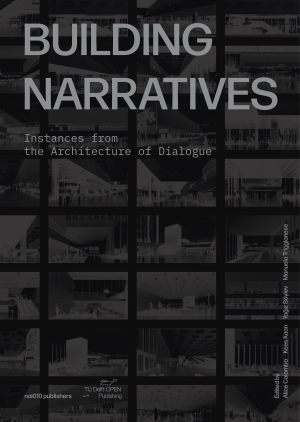
Building Narratives examines how design communication operates within these conditions. Drawing on three Amsterdam projects by KAAN Architecten, it traces how narrative functions as an operational instrument: the structure that keeps collective work legible across disciplines, procurement phases, and changing stakeholders. Through SPOT's design as negotiation in a market-driven context, the New Amsterdam Courthouse's design as integration of competing institutional demands, and Schiphol Terminal's design as activation amid continuous change, the book develops a framework grounded in Dutch practice and rooted in the specific conditions of contemporary architectural production.
Richly illustrated with diagrams, drawings, and models, Building Narratives makes visible what usually remains implicit: the collective intelligence through what architecture thinks. Developed through an ongoing collaboration between KAAN Architecten and the Complex Projects research group at Delft University of Technology, it is written for architects, urban designers, students, and decision-makers navigating the complexity of contemporary practice.
Downloads
References
Blyth, A., & Worthington, J. (2010). Managing the brief for better design (2nd ed.). Routledge. https://doi.org/10.4324/9780203857373
Carmona, M., Burgess, R., & Badenhorst, M. S. (Eds.). (2009). Planning through projects: Moving from master planning to strategic planning; 30 cities. Techne Press.
Chabard, P. (2022). Architecture as dialogue. In K. Kaan & A. Colombo (Eds.), Portraits: 15 buildings KAAN Architecten (pp. 189-204). Park Books.
Christoforetti, E. B., & Reidel, J. (2024). Documenting complexity. Instruments of Service, Harvard Design Magazine, 52.
Chua, S. M. J. (2009). Donald Schön, Herbert Simon and The Sciences of the Artificial. Design Studies, 30(1), 60-68. https://doi.org/10.1016/j. destud.2008.09.001
Cross, N. (2007). Forty years of design research. Design Studies, 28(1), 1-4. https://doi.org/10.1016/j.destud.2006.11.004
Farrell, R., & Hooker, C. (2013). Design, science and wicked problems. Design Studies, 34(6), 681-705. https://doi.org/10.1016/j. destud.2013.05.001
Harari, Y. N. (2025). NEXUS: A brief history of information networks from the Stone Age to AI. Yahav-Harari Group Ltd.
Hoog, M. de. (2013). The Dutch metropolis: Designing quality interaction environments. Thoth.
International Architecture Biennale Rotterdam. (2012, December 17). Making city: 5th IABR draws to a close [Press release].
Kaan, CHCF., & Triggianese, M. (2014). Negotiating new centralities. In M. Gausa & M. Ricci (Eds.), MED.NET.REP.02 (pp. 86-93). LISt Lab Laboratorio Internazionale Editoriale.
Malinin, L. (2018). Situated design-thinking in architectural practice: Analyzing and extending Schön's epistemology. Ardeth, 2, 53. https:// doi.org/10.17454/ARDETH02.05
Rittel, H. W. J., & Webber, M. M. (1973). Dilemmas in a general theory of planning. Policy Sciences, 4(2), 155-169. https://doi.org/10.1007/BF01405730
Rowe, P. G., & Chung, Y. (2024). Design thinking and storytelling in architecture. De Gruyter. https://doi.org/10.1515/9783035628128
Sassen, S. (2001). The global city: New York, London, Tokyo. Princeton University Press. https://doi.org/10.1515/9781400847488
Schaap, P. M. (2016, October 12). De nieuwe sleutelprojecten: Op weg naar 2030. Spoorbeeld. https://www.spoorbeeld.nl/inspiratie/ de-nieuwe-sleutelprojecten-op-weg-naar-2030
Schaathun, H. G. (2022). Where Schön and Simon agree: The rationality of design. Design Studies, 79, 101090. https://doi.org/10.1016/j. destud.2022.101090
Schaathun, H. G. (2025). On the common core of science and design. Design Studies, 98, 101305. https://doi.org/10.1016/j.destud.2025.101305
Schön, D. A. (1983). The reflective practitioner: How professionals think in action. Routledge.
Simon, H. A. (1981). The sciences of the artificial (2nd ed.). MIT Press. (Original work published 1968)
Smets, M. (2001). Il nuovo paesaggio delle infrastrutture in Europa, in Lotus International. Global Cities, n. 110, dic. 2001
Tan, L., Kocsis, A., & Burry, J. (2023). Advancing Donald Schön's Reflective Practitioner: Where to next? Design Issues, 39(3), 3-18. https://doi.org/10.1162/desi_a_00722
Terrin, J. J. (2011). Gares et dynamiques urbaines: Les enjeux de la grande vitesse. Parenthèses.
Triggianese, M. (2015). Euralille: Twenty years on. In R. J. Rutte, H. J. Engel, E. H. Gramsbergen, & O. R. Diesfeldt (Eds.), OverHolland 16/17 (pp. 111-139). Vantilt.
Triggianese, M. (2023). Design of co-creation in Rotterdam Central Station (1996-2007): Architecture and urban design roles in the multi-stakeholder collaboration. SPOOL, 10(1), 57-72. https://doi.org/10.47982/spool.2023.1.04
Wagenaar, C. (2015). Town planning in the Netherlands since 1800: Responses to Enlightenment ideas and geopolitical realities. Nai010 Publishers.
Yaneva, A. (2009). Made by the Office for Metropolitan Architecture: An ethnography of design. 010 Publishers.
Published
Data Availability Statement
No new data were created or analysed in the preparation of this publication. Therefore, data sharing is not applicable. Details of referenced sources can be found in the text and image credits.