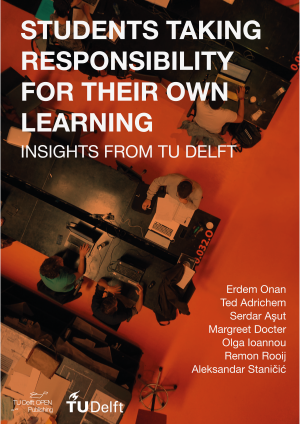
Students Taking Responsibility for Their Own Learning: Insights from TU Delft
Keywords:
Responsibility for Learning, Facilitators and Barriers of Student Responsibility, Pedagogical Affordances for Student Responsibility, Educational ApproachesSynopsis
Helping students to develop a sense of responsibility for their learning is widely recognized as a key goal of higher education. OECD identifies 'taking responsibility' as one of the three critical transformative competencies that every student should develop to navigate the unpredictable societal, economic, and environmental challenges of the future. Yet, taking responsibility, particularly in the context of learning, is a complex construct as it carries multiple meanings, interpretations, and implications.
TU Delft's IDEE (Innovation in Delft Engineering Education) Initiative aims to address these complexities within the Students Taking Responsibility for Their Own Learning Process theme. This book, which is one of the early outputs of this initiative, presents our initial findings and lays the foundation for future research.
Downloads
References
Anderson, T. (2016). Theories for learning with emerging technologies. In G. Veletsianos (Ed.), Emergence and innovation in digital learning: Foundations and applications, (pp. 35-50). Athabasca University Press.
Barnett, R. (2004). Learning for an unknown future. Higher Education Research & Development, 23(3), 247-260. https://doi.org/10.1080/0729436042000235382
Barnett, R. (2018). The ecological university: A feasible utopia. Routledge, Taylor & Francis Group. https://doi.org/10.4324/9781315194899
Barron, K. E. & Hulleman, C. S. (2015). Expectancy-value-cost model of motivation. Psychology, 84, 261-271. https://doi.org/10.1016/B978-0-08-097086-8.26099-6
Bianchi, G., Pisiotis, U., & Cabrera Giraldez, M. (2022). GreenComp: The European sustainability competence framework (EUR 30955 EN). Publications Office of the European Union. https://doi.org/10.2760/13286
Biwer, F., Egbrink, M. G. A. O., Aalten, P., & de Bruin, A. B. H. (2020). Fostering effective learning strategies in higher education – a mixed methods study. Journal of Applied Research in Memory and Cognition, 9(2), 186-203. https://doi.org/10.1016/j.jarmac.2020.03.004
Bjork, E. L., & Bjork, R. A. (2011). Making things hard on yourself, but in a good way: Creating desirable difficulties to enhance learning. In M.A. Gernsbacher, R.W. Pew, L.M. Hough, & J.R. Pomerantz (Eds.), Psychology and the real world: Essays illustrating fundamental contributions to society (pp. 59-68). Worth Publishers.
Bjork, R. A., Dunlosky, J., & Kornell, N. (2013). Self-regulated learning: Beliefs, techniques, and illusions. Annual Review of Psychology, 64(1), 417-444. https://doi.org/10.1146/annurev-psych-113011-143823
Boxall, M. (2025). The changing futures of engineering education. TU Delft looking towards 2050. TU Delft. https://filelist.tudelft.nl/TUDelft/About/Strategie/TUD-Rapport%20-%20Changing%20Futures%20of%20Engineering%20Education_FINAL-2.pdf
Cormier, D. (2008). Rhizomatic education: Community as curriculum. Innovate: Journal of Online Education, 4(5), Article 2. https://www.researchgate.net/publication/234577448_Rhizomatic_Education_Community_as_Curriculum
Damşa, C., Nerland, M., & Andreadakis, Z. E. (2019). An ecological perspective on learner-constructed learning spaces. British Journal of Educational Technology, 50(5), 2075-2089. https://doi.org/10.1111/bjet.12855
De Bruin, A. B., Biwer, F., Hui, L., Onan, E., David, L., & Wiradhany, W. (2023). Worth the effort: The start and stick to desirable difficulties (S2D2) framework. Educational Psychology Review, 35(2), Article 41. https://link.springer.com/article/10.1007/s10648-023-09766-w
De Bruyckere, P., Kirschner, P. A., & Hulshof, C. D. (2015). Urban myths about learning and education. Academic Press. https://doi.org/10.1016/B978-0-12-801537-7.00003-2
Deci, E. L., & Ryan, R. M. (2002). Self-determination research: Reflections and future directions. In E. L. Deci & R. M. Ryan (Eds.), Handbook on self-determination research (pp. 431 – 441). University of Rochester Press.
Delft University of Technology (2024a). Strategic agenda TU Delft 2024-2030 – Impact for a sustainable society. TU Delft. https://filelist.tudelft.nl/TUDelft/Over_TU_Delft/Strategie/Institutional%20plan%20TU%20Delft%20-%20EN-DEF-online.pdf
Delft University of Technology (2024b). Vision on education 2024-2030 – Educating future-proof engineers. TU Delft. https://filelist.tudelft.nl/TUDelft/About/Strategie/Vision%20on%20Education_Printversion_ENNL-compressed.pdf
Evans, M., & Boucher, A. R. (2015). Optimizing the power of choice: Supporting student autonomy to foster motivation and engagement in learning. Mind, Brain, and Education, 9(2), 87-91. https://doi.org/10.1111/mbe.12073
Farnsworth, V., Kleanthous, I., & Wenger-Trayner, E. (2016). Communities of practice as a social theory of learning: A conversation with Etienne Wenger. British Journal of Educational Studies, 64(2), 139-160. https://doi.org/10.1080/00071005.2015.1133799
Fishman, E. J. (2014). With great control comes great responsibility: The relationship between perceived academic control, student responsibility, and self-regulation. British Journal of Educational Psychology, 84(4), 685-702. https://doi.org/10.1111/bjep.12057
Flavell, J. H. (1979). Metacognition and cognitive monitoring: A new area of cognitive–developmental inquiry. American Psychologist, 34(10), 906-911. https://doi.org/10.1037/0003-066X.34.10.906.
Garrison, D. R., Anderson, T., & Archer, W. (2010). The first decade of the community of inquiry framework: A retrospective. The Internet and Higher Education, 13(1), 5-9. https://doi.org/10.1016/j.iheduc.2009.10.003
Ioannou, O., Geldermans, B., Klein, T., & Wandl, A. (2022). Planning for Change: A Methodological Framework for Integrating Circularity at TU Delft’s Faculty of Architecture and the Built Environment Curricula. Serbian Architectural Journal, 12(3), 234-269. https://doi.org/10.5937/saj2003234I
Jääskelä, P., Poikkeus, A.-M., Vasalampi, K., Valleala, U. M., & Rasku-Puttonen, H. (2017). Assessing agency of university students: validation of the AUS Scale. Studies in Higher Education, 42(11), 2061-2079. https://doi.org/10.1080/03075079.2015.1130693
Kalina, C., & Powell, K. (2009). Cognitive and social constructivism: Developing tools for an effective classroom. Education, 130(2), 241-250.
Hase, S., & Kenyon, C. (2001). Moving from andragogy to heutagogy: Implications for VET. In Proceedings of Research to Reality: Putting VET Research to Work: Australian Vocational Education and Training Research Association (AVETRA). AVETRA. https://researchportal.scu.edu.au/esploro/outputs/conferencePaper/Moving-from-andragogy-toheutag%20ogy-implications/991012820997202368
Kim, A. S. N., Shakory, S., Azad, A., Popovic, C., & Park, L. (2020). Understanding the impact of attendance and participation on academic achievement. Scholarship of Teaching and Learning in Psychology, 6(4), 272-284. https://doi.org/10.1037/stl0000151
Kirk-Johnson, A., Galla, B. M., & Fraundorf, S. H. (2019). Perceiving effort as poor learning: The misinterpreted-effort hypothesis of how experienced effort and perceived learning relate to study strategy choice. Cognitive Psychology, 115, Article 101237. https://doi.org/10.1016/j.cogpsych.2019.101237
Kohn, A. (2018). Punished by Rewards. The trouble with gold stars, incentive plans, A’s, praise, and other bribes. (Twenty-fifth anniversary edition). Harperone Publishers.
Lauermann, F., & Karabenick, S. A. (2011). Taking teacher responsibility into account(ability): Explicating its multiple components and theoretical status. Educational Psychologist, 46(2), 122-140. https://doi.org/10.1080/00461520.2011.558818
Mayer, R. E. (1992). Cognition and instruction: Their historic meeting within educational psychology. Journal of Educational Psychology, 84(4), 405-412. https://doi.org/10.1037/0022-0663.84.4.405
Mostafavi, M. (n.d.). How will we teach next? Notes for a conversation on the futures of architectural education. urbanNext. https://urbannext.net/how-will-we-teach-next/
Nelson, T. O., & Narens, L. (1994). Why investigate metacognition. In J. Metcalfe & A.P. Shimamura (Eds.), Metacognition: Knowing about knowing (pp. 1-25). The MIT Press. https://doi.org/10.7551/mitpress/4561.003.0003
O’Connell, M. T., Stöhr, C., Wallin, P., & Negretti, R. (2024). Social regulation of learning in interdisciplinary groupwork. European Journal of Engineering Education, 49(4), 683-699. https://doi.org/10.1080/03043797.2023.2292258
OECD. (2019). An OECD learning framework 2030. In G. Bast, E.G. Carayannis, & D.F.J. Campbell (Eds.), The future of education and labor (pp. 23-35). Springer International Publishing. https://doi.org/10.1007/978-3-030-26068-2_3
Onan, E., Biwer, F., Abel, R., Wiradhany, W., & de Bruin, A. (2024). Optimizing self-organized study orders: Combining refutations and metacognitive prompts improves the use of interleaved practice. Science of Learning, 9(1), Article 33. https://doi.org/10.1038/s41539-024-00245-7
Palincsar, A. S. (1998). Social constructivist perspectives on teaching and learning. Annual Review of Psychology, 49, 345-375. https://doi.org/10.1146/annurev.psych.49.1.345
Paris, S. G., & Paris, A. H. (2003). Classroom applications of research on self-regulated learning. Educational Psychologist, 36(2), 89-101. https://doi.org/10.1207/S15326985EP3602_4
Pintrich, P. R., & Zusho, A. (2007). Student motivation and self-regulated learning in the college classroom. In R.P. Perry & J.C. Smart (Eds.), The scholarship of teaching and learning in higher education: An evidence-based perspective (pp. 731-810). Springer. https://doi.org/10.1007/1-4020-5742-3_16
Rakoczy, K., Pinger, P., Hochweber, J., Klieme, E., Schütze, B., & Besser, M. (2019). Formative assessment in mathematics: Mediated by feedback’s perceived usefulness and students’ self-efficacy. Learning and Instruction, 60, 154-165. https://doi.org/10.1016/j.learninstruc.2018.01.004
Reeve, J., & Jang, H. (2006). What teachers say and do to support students’ autonomy during a learning activity. Journal of Educational Psychology, 98(1), 209-218. https://doi.org/10.1037/0022-0663.98.1.209
Rocca, K. A. (2010). Student participation in the college classroom: An extended multidisciplinary literature review. Communication Education, 59(2), 185-213. https://doi.org/10.1080/03634520903505936
Schunk, D. H. (2005). Self-regulated learning: The educational legacy of Paul R. Pintrich. Educational Psychologist, 40(2), 85-94. https://doi.org/10.1207/s15326985ep4002_3
Siemens, G. (2005). Connectivism: A learning theory for the digital age. International Journal of Instructional Technology & Distance Learning, 2(1).
Soderstrom, N. C., & Bjork, R. A. (2015). Learning versus performance: An integrative review. Perspectives on Psychological Science, 10(2), 176-199. https://doi.org/10.1177/1745691615569000
Van den Hoven, J., Lokhorst, G.-J., & Van de Poel, I. (2012). Engineering and the problem of moral overload. Science and Engineering Ethics, 18(1), 143-155. https://doi.org/10.1007/s11948-011-9277-z
Veenman, M. V. (2015). Metacognition. In P. Afflerbach (Ed.), Handbook of individual differences in reading, reader, text, and context (pp. 26–40). Routledge.
Watson, J. B. (1913). Psychology as the behaviorist views it. Psychological Review, 20(2), 158-177. https://doi.org/10.1037/h0074428
Wigfield, A., & Eccles, J. S. (2000). Expectancy-value theory of achievement motivation. Contemporary Educational Psychology, 25(1), 68-81. https://doi.org/10.1006/ceps.1999.1015
Wijnia, L., Noordzij, G., Arends, L. R., Rikers, R. M., & Loyens, S. M. (2024). The effects of problem-based, project-based, and case-based learning on students’ motivation: A meta-analysis. Educational Psychology Review, 36(1), 29. https://doi.org/10.1007/s10648-024-
09864-3
Winne, P. H., & Hadwin, A. F. (1998). Studying as self-regulated learning. In D.J. Hacker, J. Dunlosky, & A.C. Graesser (Eds.), Metacognition in educational theory and practice (pp. 277-304). Routledge.
Zimmerman, B. J. (2002). Becoming a self-regulated learner: An overview. Theory Into Practice, 41(2), 64-70. https://doi.org/10.1207/s15430421tip4102_2
Zimmerman, B. J., & Kitsantas, A. (2005). Homework practices and academic achievement: The mediating role of self-efficacy and perceived responsibility beliefs. Contemporary Educational Psychology, 30(4), 397-417. https://doi.org/https://doi.org/10.1016/j.cedpsych.2005.05.003
Zimmerman, B.J., & Risemberg R. (1997). Self-regulatory dimensions of academic learning and motivation. In G.D. Phye (Ed.), Handbook of academic learning: Construction of knowledge (pp. 105-125). Academic. https://doi.org/10.1016/B978-012554255-5/50005-3
Published
Series
Categories
Data Availability Statement
Data availability differs between chapters. For chapters where data is shared, specific details and access information are provided within that chapter. If datasets or supplementary materials are available from external sources, these sources are listed in the chapter's bibliography.