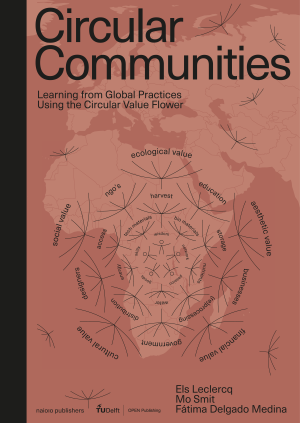
Circular Communities: Learning from Global Practices using the Circular Value Flower
Keywords:
community, circular and regenerative entrepreneurship, multiple value creation, collaboration, designSynopsis
From local action to global inspiration: how communities around the world are shaping a circular future through collective, relational, and regenerative entrepreneurial practices. Building on the first edition of Circular Communities (2022), this second edition explores culturally diverse and community-led approaches to circular resource stewardship. These examples demonstrate how communities generate ecological, cultural, social, aesthetic and financial value by collectively closing resource loops.
In their new book, urban designer Els Leclercq, architect Mo Smit and regenerative entrepreneurship expert Fátima Delgado Medina expand on the Circular Value Flower: a value-based, relational model developed to analyse, communicate and design circular practices. This enables a holistic environmental approach by linking communities with the (urban) landscape and wider eco-system through resource stewardship.
Written for communities, spatial designers, policymakers, researchers, and practitioners, this book offers insights and instruments with which to design, collaborate, and act - supporting global circular practices and allowing these to flourish, connect, and grow into valuable networks.
Downloads
References
Acosta, A. (2012). Buen vivir Sumak Kawsay: una oportunidad para imaginar otros mundos. Editorial Abya-Yala.
Afrikaanderwijk Coöperatie. (2017). Business case circulaire afrikaandermarkt (Internal business case document). Afrikaanderwijk Coöperatie. Rotterdam. https://www.wijkcooperatie.org
Afrikaanderwijk Coöperatie. (2018). Resultatenverslag pilot wijkbeheer afrikaandermarkt (pilot evaluation report for the Circulaire Afrikaandermarkt). Afrikaanderwijk Coöperatie. Rotterdam.
Afrikaanderwijk Coöperatie. (2023). Projectplan circulaire afrikaandermarkt 2024-2027 (tech. rep.) (Funding application Kansen voor West (GTI-Klimaat 2.0SR. G1)). Afrikaanderwijk Coöperatie. Rotterdam.
Afrikaanderwijk Coöperatie. (2024). Het Grondstoffenstation. https://wijkcooperatie.org/nl/diensten/het_grondstoffenstation/
Afrikaanderwijk Coöperatie. (2025a). Home - de afrikaanderwijk coöperatie. https://wijkcooperatie.org/nl/home/
Afrikaanderwijk Coöperatie. (2025b). Projectplan circulaire markt 2025, versie 2 (tech. rep.) (Operational work plan and annual budget for 2025). Afrikaanderwijk Coöperatie. Rotterdam.
Arjaliès, L., & Banerjee, S. B. (2024). 'Let's Go to the Land Instead': Indigenous Perspectives on Biodiversity and the Possibilities of Regenerative Capital. Journal of Management Studies. https://doi.org/10.1111/joms.13141 https://doi.org/10.1111/joms.13141
Bacq, S., Hertel, C., & Lumpkin, G. (2022). Communities at the nexus of entrepreneurship and societal impact: A cross-disciplinary literature review. Journal of Business Venturing, 37(5), 106231. https://doi.org/10.1016/j.jbusvent.2022.106231 https://doi.org/10.1016/j.jbusvent.2022.106231
Bosschaert, T. (2022), Circularity is not sustainability - how well-intentioned concepts distract us from our true goals, and how SiD can help navigate that challenge. The Impossibilities of the Circular Economy - Separating Aspirations from Reality. New York: Routledge. See also: https://360dialogues.com/360portfolios/ce-impossibilities https://doi.org/10.4324/9781003244196-9
Brand, S. (1994). How Buildings Learn: What Happens After They're Built. Viking.
Buijsman, N. A.(2025). From extractive to regenerative insular food systems: Uncovering the entrepreneurial barriers and opportunities towards shaping a regenerative productive food system in the Galápagos Archipelago, guided by the principles of circular communities (master's thesis, Delft University of Technology). Delft University of Technology. https://resolver.tudelft.nl/uuid:d22e961c-74c0-496f-8bd7-4e118afca1de
Buijsman, N.A. (2025). From extractive to regenerative insular food systems: Uncovering the entrepreneurial barriers and opportunities towards shaping a regenerative productive food system in the Galápagos Archipelago, guided by the principles of circular communities. (Master's thesis, Delft University of Technology). Delft University of Technology. https://resolver.tudelft.nl/uuid:d22e961c-74c0-496f-8bd7-4e118afca1de
Castrejón, M., & Defeo, O. (2025). Towards an ecosystem approach to fisheries in the Galapagos Marine Reserve: A science-driven and adaptive co-management framework (Manuscript in preparation). Grupo de Investigación en Biodiversidad, Medio Ambiente y Salud, Universidad de Las Américas; Laboratorio de Ciencias del Mar, Facultad de Ciencias, Montevideo. https://doi.org/10.1016/j.marpol.2025.106857
Castrejón, M., Delgado, F., Leclercq, E., & Díaz, Á. (2024). Empowering Circular Communities in the Galápagos Islands. Quito, Ecuador.
Cheok, J., van Velden, J., Fulton, E.A. et al. Framings in Indigenous futures thinking: barriers, opportunities, and innovations. Sustain Sci 20, 613-633 (2025). https://doi.org/10.1007/s11625-024-01615-1 https://doi.org/10.1007/s11625-024-01615-1
Conedera, M., Tinner, W., Krebs, P., de Rigo, D., Caudullo, G., 2016. Castanea sativa in Europe: distribution, habitat, usage and threats. In: San-Miguel-Ayanz, J., de Rigo, D., Caudullo, G., Houston Durrant, T., Mauri, A. (eds.), European Atlas of Forest Tree Species. Publ. Off. EU, Luxembourg.
Da Ronch, F., Caudullo, G., de Rigo, D., 2016. Pseudotsuga menziesii in Europe: distribution, habitat, usage and threats. San-Miguel-Ayanz, J., de Rigo, D., Caudullo, G., Houston Durrant, T., Mauri, A. (eds.), European Atlas of Forest Tree Species. Publ. Off. EU, Luxembourg.
Dahlan, M.Z., Katsue, F., Imanishi, J., Shibata, S. (2016). Local people's knowledge of plants in a kabuyutan sacred natural site in Indonesia and its implication for environmental conservation. Journal of the Japanese Society of Revegetation Technology, No. 8 Vol.1, ISSN 0916-7439. https://doi.org/10.7211/jjsrt.42.32 https://doi.org/10.7211/jjsrt.42.32
Dambrink, D., Docter, B., Eland, M., & Peters, J. (2025). Galápagos Islands: Circular fish waste solutions (student report). Delft University of Technology.
Dasgupta, P. (2021). The Economics of Biodiversity: The Dasgupta Review. Full Report. London: HM Treasury. https://www.gov.uk/government/publications/final-report-the-economics-ofbiodiversity-the-dasgupta-review
De Bruijn, M., Ooteman, M., Segers, H., & Verhalle, B. (2024). From waste to wealth: Turning fish waste into opportunity in Pelican Bay, Puerto Ayora (student report). Delft University of Technology.
Delgado. F., Leclercq, E., Díaz-Marquez. A., Castrejón, M., Quadros, L. & Bezemer, M. (2025). Leveraging Empowered Circular Communities in the Galápagos Islands, Ecuador: A Promising Pathway to Sustainable Development and Conservation (final report). LDE Global Fund. The Netherlands. https://doi.org/10.59490/mt.262
Denny, L., Bate, C. S., Bradford, J., Bradford, R., Bailey, M., Brooks, W., Jr., Denny, S., Denny, S., Iverson, S., Jeddore, S., Henger, B., Harvey-Clark, C., Lennox, R. J., Leslie, A., Marsala, M., Stokesbury, M. J. W., Syliboy, A., Taylor, A., & Whoriskey, F. (2025). Electroimmobilization of fishes for surgical implantation of acoustic tags: Advancing the ethical application of new technology through the incorporation of Mi'kmaw values. The Journal of Ocean Technology, 20(4), 26-37. https://doi.org/10.48336/88NG-4973
Denny, S. K., Denny, A. P., & Gillis, D. (2025). Netukulimk and Two-Eyed Seeing: Indigenous approaches to fisheries sustainability and governance. The Oxford Handbook of Indigenous Peoples and the Ocean (pp. 1-22). Oxford University Press.
Dietz, T., Ostrom, E., Stern, P. (2003). The Struggle to Govern the Commons. Science. 302 (5652), 1907-1912. https://doi.org/10.1126/science.162.3859.1243 https://doi.org/10.1126/science.162.3859.1243
Eisenstein, C. (2021). Sacred Economics - Money, Gift and Society in the Age of Transition. North Atlantic Books.
Elhacham, E., Ben-Uri, L., Grozovski, J., Bar-On, Y.M., and Milo, R. (2020). Global human-made mass exceeds all living biomass. Nature 588(7838), 442-444. https://doi.org/10.1038/s41586-020-3010-5 https://doi.org/10.1038/s41586-020-3010-5
Ellen MacArthur Foundation, (2021). Universal Circular Economy Policy Goals (2021).
European Commission: Directorate- General for Environment, Guidelines on closer-to-nature forest management, Publications Office of the European Union, 2023. https://data.europa.eu/doi/10.2779/731018
Evans, J., Karvonen, A., Raven, R. (eds). 2016. The Experimental City. London: Routledge. https://doi.org/10.4324/9781315719825
Even modest climate change may lead to major transitions in boreal forests. Nature 608, 540-545 (2022). https://doi.org/10.1038/s41586-022-05076-3 https://doi.org/10.1038/s41586-022-05076-3
Ewuoso, C., & Hall, S. (2019). Core aspects of ubuntu: A systematic review. South African Journal of Bioethics and Law, 12(2), 93-103. https://doi.org/10.7196/SAJBL.2019.v12i2.679
Fraser, M., Conde, Á., & Haigh, L. (2024). The Circularity Gap Report 2024: A roadmap to lead the world towards the circular economy. Circle Economy. https://cgrreports.s3.eu-west-1.amazonaws.com/cgr-global-2024-37b5f198/CGR+Global+2024+-+Report.pdf
Fraser, M., Conde, Á., & Haigh, L. (2024). The Circularity Gap Report 2024: A roadmap to lead the world towards the circular economy. Circle Economy.
From Climate Risk to Resilience: unpacking the Economic Impacts of Climate Change in Kenya (2023). African Climate Foundation. https://africanclimatefoundation.org/wp-content/uploads/2023/11/800832-ACF-Kenya-country-note-04.pdf
Fuchs, A.. Tillie, N., Smit, M.J. (2019). Developing a Decentralized and Integrated Water Management System for Neighborhood Communities within Indonesia's Informal Urban Settlements. Conference paper and presentation at EcoCity World Summit 2019, Vancouver, Canada. https://doi.org/10.1007/978-3-030-58399-6_3
Ghisellini, P., Cialani. C., Ulgiati. S. (2016). A review on circular economy: the expected transition to a balanced interplay of environmental and economic systems. Journal of Cleaner Production. 114(7): 11-32. https://doi.org/10.1016/j.jclepro.2015.09.007 https://doi.org/10.1016/j.jclepro.2015.09.007
Gooise markegenoten (1280-1568). Retrieved from https://hdl.handle.net/1887/14523
Grassroots Innovations with Multiple Pathways and Outcomes. Ecological Economics. 158: 88-100. https://doi.org/10.1016/j.ecolecon.2018.12.019
Gudynas, E. (2011). Buen Vivir: Today's tomorrow. Development, 54(4), 441-447. https://doi.org/10.1057/dev.2011.86 https://doi.org/10.1057/dev.2011.86
Guenther, G. (2025). Another Cop wrecked by fossil fuel interests and our leaders' cowardice - but there is another way. The Guardian, 24/11/2025
Hardin, G. (1968). The Tragedy of the Commons: The population problem has no technical solution; it requires a fundamental extension in morality. Science. 162 - 3859 pp. 1243-1248 https://doi.org/10.1126/science.162.3859.1243
Haryanto, E.T., Herwanto, E., Kendarto, R. (2007). Perubahan Bentuk Penggunaan Lahan dan Implikasinya Terhadap Koefisien Air Larian DAS Citarum Hulu Jawa-Barat (Land-use Change and the Implication to Runoff Coefficient in the Upper Citarum Catchment West Java). Jurnal Bionatura, 9(1), 1-5.
Hermus, M., Brinkman, G., Van Buuren, A. (2020). Van recht naar reden - naar een toekomst waarin samenwerking tussen stad en initiatief geen recht maar een vanzelfsprekendheid is. https://www.eur.nl/en/media/2020-10-r2ceindrapportpersbericht00
Hobson, K. (2016). Closing the loop or squaring the circle? Locating generative spaces for the circular economy. Progress in Human Geography, 40(1), 88-104. https://doi.org/10.1177/0309132514566342
Horwedel, O., 'Anolani Alegado, R., Augustine, S., Ballew, L., Ballew, T., Barber, J. S., Boure, A., Chang, K., Crim, R., Crisostomo, D., Donatuto, J., Eckert, G., Greiner, C., Hatch, M., Hintzen, K., Ito, W., Kotubetey, K., Lanphier, K., Lima, B., Poe, M. (2025). Reawakening ancestral ocean technologies, healing communities, and ensuring intergenerational food sovereignty: Lessons from Indigenous aquaculture. The Journal of Ocean Technology, 20(4), 1-13.
https://nairobi.go.ke/download/nairobicity-county-climate-action-plan-2020-2050
https://nbsguide.org/Forest/Closer-tonature-forest-management
https://www.prosilva.org/close-tonature-forestry/pro-silva-principles/production/
Hughes, S., Hoffmann, M. (2020). Just urban transitions: Toward a research agenda. Wiley Interdisciplinary Reviews: Climate Change, 11(3). https://doi.org/10.1002/wcc.640
IPCC, 2022: Climate Change 2022: Impacts, Adaptation and Vulnerability. Contribution of Working Group II to the Sixth Assessment Report of the Intergovernmental Panel on Climate Change (H.-O. Pörtner, D.C. Roberts, M. Tignor, E.S. Poloczanska, K. Mintenbeck, A. Alegría, M. Craig, S. Langsdorf, S. Löschke, V. Möller, A. Okem, B. Rama (eds.)). Cambridge University Press. Cambridge University Press, Cambridge, UK and New York, NY, USA, 3056 https://doi.org/10.1017/9781009325844 https://doi.org/10.1017/9781009325844
Jansen, J.J., & Oosterbaan, A. (2018). Opbrengsttabellen Nederland 2018. Wageningen University & Research. https://doi.org/10.3920/978-90-8686-876-6
JICA (2010). The Preparatory Survey for Upper Citarum Basin Tributaries Flood Management Project in Indonesia.
Kaur Paramjit, K. (2025). Circular Communities 1+1=3, an exploration through the lens of grassroot initiatives, Nairobi, Kenya, (Master's thesis, Delft University of Technology). Delft University of Technology.
Keck, F., Peller, T., Alther, R. et al. The global human impact on biodiversity. Nature 641, 395-400 (2025). https://doi.org/10.1038/s41586-025-08752-2 https://doi.org/10.1038/s41586-025-08752-2
Kimeu, C. (2024). 'I've only the clothes on my back': lives swept away by floods in Kenya. The Guardian, 7/5/2024. https://www.theguardian.com/global-development/article/2024/may/07/floods-kenya-
Kirchherr, J., Jones, M., Geissdoerfer, M. & Coffay, M. (2025). A defense of the circular economy. Journal of Industrial Ecology, 29:6, 1959-1976. https://doi.org/10.1111/jiec.70128
Konietzko, J., Das, A., Bocken, N., (2023). Towards regenerative business models: A necessary shift?, Sustainable Production and Consumption. Volume 38 pp. 372-388. https://doi.org/10.1016/j.spc.2023.04.014
Kos, H.A. (2009, June 24). Van meenten tot marken : een onderzoek naar de oorsprong en ontwikkeling van de Gooise marken en de gebruiksrechten op de gemene gronden van de Reich, P.B., Bermudez, R., Montgomery, R.A. et al.
Kovacic, Z., Strand, R., & Völker, T. (2020). The circular economy in Europe: Critical perspectives on policies and imaginaries. Taylor & Francis. https://doi.org/10.4324/9780429061028
Leclercq, E., Smit, M., Delgado Medina, F., Fransen, J., Spierenburg, M. (2025). Circular Communities as a Driver for Nairobi's River Regeneration: an urgent call for climate adaptability through multiple value creation. Report https://researchgate.net/publication/396271268_CIRCULAR_COMMUNITIES_AS_A_DRIVER_FOR_NAIROBI'S_RIVER_REGENERATION_an_urgent_call_for_climate_adaptability_through_multiple_value_creation https://doi.org/10.59490/mt.262
Lloyd, K., Fullagar, S., Reid, S., (2016). Where is the 'Social' in Constructions of 'Liveability'? Exploring Community, Social Interaction and Social Cohesion in Changing Urban Environments, Urban Policy and Research, 34:4, 343-355. https://doi.org/10.1080/08111146.2015.1118374
Loorbach, D., Patteeuw, V., Szacka, L., & Veenstra, P. (2024). It's about time. The architecture of climate change. nai010 publishers.
Ludwig, D., & El-Hani, C. N. (2025). Transformative transdisciplinarity: An introduction to community-based philosophy. Oxford University Press. https://doi.org/10.1093/9780197815281.001.0001 https://doi.org/10.1093/9780197815281.001.0001
Maracle, S., Maracle, J., & Lougheed, S. (2025). Understanding Indigenous knowledge of conservation and stewardship before implementing co-production with Western methodologies in resource management: A focus on fisheries and aquatic ecosystems. Journal of Agriculture, Food Systems, and Community Development, 14(1), 75-86. https://doi.org/10.5304/jafscd.2025.141.024 https://doi.org/10.5304/jafscd.2025.141.024
Marletto, G., Sillig, C., (2019) Lost in Mainstreaming? Agrifood and Urban Mobility
Martinez, D. J., Cannon, C. E., McInturff, A., Alagona, P. S., & Pellow, D. N. (2023). Back to the future: Indigenous relationality, kincentricity and the North American Model of wildlife management. Environmental Science & Policy, 140, 202-207. https://doi.org/10.1016/j.envsci.2022.12.010 https://doi.org/10.1016/j.envsci.2022.12.010
McPhearson, T., Haase, D., Kabisch, N., Gren, Å. (2016). Advancing understanding of the complex nature of urban systems. Ecological Indicators. 70:566-573.
Moreno, J., García, S., Vera, M., & Obregon, P. (2020). Reporte sobre la identificación de los productos de desechos de pescado que se generan en la Cooperativa de Producción Pesquera Artesanal Galápagos (COPROPAG) y el Muelle Pelican Bay. Puerto Ayora, Galápagos.
Mugumbate, J., & Chereni, A. (2019). Using African Ubuntu theory in social work with Children in Zimbabwe. African Journal of Social Work, 9(1), 27-34.
Nairobi City Council Climate Action Plan 2020-2050 (2022). Nairobi Rivers Commission. https://nrc.or.ke/mission-vision-corevalues/
OECD (2020), How's Life? 2020: Measuring Well-being. OECD Publishing, Paris. https://doi.org/10.1787/9870c393-en https://doi.org/10.1787/9870c393-en
Ombudsman Rotterdam Rijnmond (2025). Omarm me: nieuw onderzoek naar hoe vijf gemeenten omgaan met hun initiatiefrijke inwoners (Embrace me: new research into how five municipalities deal with local initiatives). Retrieved from: https://orr.nl/omarm-me/
Ostrom, E. (1990). Governing the Commons: The Evolution of Institutions for Collective Action. Cambridge: Cambridge University Press. https://doi.org/10.1017/CBO9780511807763
Ostrom, E. (2009). A General Framework for Analyzing Sustainability of Social-Ecological Systems. Science. 325 (5939), 419-422. https://doi.org/10.1126/science.1172133
Ostrom, E., Burger. J., Field, C., Norgaard, R., Policansky, D. (1999). Revisiting the Commons: Local Lessons, Global Challenges. Science, 284(5412). 278-282. https://doi.org/10.1126/science.284.5412.278
Raworth, K. (2017). Doughnut Economics. Seven Ways to Think Like a 21st-Century Economist. London: Penguin Random House
Rayner, C., Otoo, S., & Bonnici, F. (2025). The future of innovation is collective. Stanford Social Innovation Review, 23(3), 28-39. https://doi.org/10.48558/7RH3-1M81
Richardson, M. (2025). Modelling Nature Connectedness Within Environmental Systems: Human-Nature Relationships from 1800 to 2020 and Beyond. Earth, 6(3), 82. https://doi.org/10.3390/earth6030082 https://doi.org/10.3390/earth6030082
Rietz, R.C., & Page, R.H. (1971). Air drying of lumber: A guide to industry practices. Agriculture Handbook No. 402. U.S. Department of Agriculture, Forest Service.
Rijshouwer, E. (2026). Jouw toekomst is niet de mijne. STT Horizonscan 2055
Sands, B., Machado, M. R., White, A., Zent, E., & Gould, R. (2023). Moving towards an anti-colonial definition for regenerative agriculture. Agriculture and Human Values, 40(4),1697-1716. https://doi.org/10.1007/s10460-023-10429-3 https://doi.org/10.1007/s10460-023-10429-3
Schelhaas, M.J., Teeuwen, S., Oldenburger, J., Beerkens, G., Velema, G., Kremers, J., Lerink, B., Paulo, M.J., Schoonderwoerd, H., Daamen, W., Dolstra, F., Lusink, M., van Tongeren, K., Scholten, T., Pruijsten, I., Voncken, F., & Clerkx, A.P.P.M. (2022). Zevende Nederlandse Bosinventarisatie: Methoden en resultaten. (WOt-rapport; No. 142). WOT Natuur & Milieu. https://doi.org/10.18174/571720 https://doi.org/10.18174/571720
Schouten, M., Van Riel, E. (2025). Anders Kijken, over partnerschap met de natuur. Uitgeverij Noordhoek. https://www.natuurcollege.nl/maatschapwij-hoe-we-een-duurzametoekomst-creeren-door-ons-westersewereldbeeld-te-herzien-2020/
Schumacher. E.F. (1973). Small Is Beautiful: A Study of Economics As If People Mattered. Harper Collins.
Scobie, M., Poyser, A. & Hampton, G. Tangata Whenua. People Born of the Land: From Corporate Dispossession and Repossession to Severance and Reconnection. J Bus Ethics (2025). https://doi.org/10.1007/s10551-025-06048-z https://doi.org/10.1007/s10551-025-06048-z
Slaveikova Nikolova, A., Ness, D. (2023). 'The impossible dream': can the circular economy alone solve waste management complexities of the Global South? The Impossibilities of the Circular Economy Separating Aspirations from Reality. Edited by Lehmann, H., Hinske, C., De Margerie, V., Slaveikova Nikolova, A. London: Routledge. https://doi.org/10.4324/9781003244196-4
Smit, M.J., Groenendijk, R., Köbben, R., Vélu, D., 2022. Stichting Bouwtuin, Naar een Nieuwe Streekarchitectuur.
Soeterbroek, F. (2015). Stadsmakers als happy infiltrators in de systeemwereld (City-makers as happy infiltrators in the systemic world). In: Franke, S., Niemans, J., Soeterbroek, F. Het Nieuwe Stadmaken - Van gedreven pionieren naar gelijk speelveld (The New City-making - From passionate pioneering to a level playing field). TrancityXValiz.
Sylliboy, J. R. (2025). Etuaptmumk: Cultural Foundations of Two-Eyed Seeing for Conducting L'nu Research in Mi'kma'ki. Canadian Journal of Native Studies, 42(2).
Taets van Amerongen, V., Boudewijn, B., & Agrawal, D. (2024). A roadmap towards sustainable fish leather production in the Galapagos Islands (student report). Delft University of Technology.
Törnberg, A. (2021). Prefigurative politics and social change: a typology drawing on transition studies. Distinktion: Journal of Social Theory Volume 22, 2021 - Issue 1. https://doi.org/10.1080/1600910X.2020.1856161
Trebeck, K., and Williams, J. (2019). The Economics of Arrival: Ideas for a grown-up economy. Bristol: Policy Press. https://doi.org/10.46692/9781447337843
UNESCO. (2026). How Indigenous knowledge drives scientific discovery. The UNESCO Courier, (1), 1-45. https://unesdoc.unesco.org https://doi.org/10.18356/22202293-2026-1-1
Vakfederatie Rietdekkers (Professional Thatchers' Association): https://riet.com/kennisbank/natuurlijk-riet
Van den Hoven, F., Dekker, S., Van de Hoef, R. (2025) Enhancing Community Resilience in Nairobi, Kenya (student report). Delft University of Technology.
Van der Schot, J. (2016). Besturen met Burgerkracht, samenspel in de energieke samenleving (Governing with Citizen Power, Interplay in the Energetic Society). Retrieved from: https://www.duurzaamdoor.nl/sites/default/files/2019-02/Duurzaam%20Door%20Besturen%20door%20Burgerkracht%20proef5.pdf
Van Reybrouck, D. (2016). Tegen Verkiezingen (Against Elections). Uitgeverij De Bezige Bij b.v.
Vanhulst, J., & Beling, A. E. (2014). Buen vivir: Emergent discourse within or beyond sustainable development? Ecological Economics, 101, 54-63. https://doi.org/10.1016/j.ecolecon.2014.02.017 https://doi.org/10.1016/j.ecolecon.2014.02.017
Velenturf, A., Purnell, P., (2021). Principles for a sustainable circular economy, Sustainable Production and Consumption, vol. 27, pp. 1437-1457, https://doi.org/10.1016/j.spc.2021.02.018 https://doi.org/10.1016/j.spc.2021.02.018
Vogt, J.M., G.B. Epstein, S.K. Mincey, B.C. Fischer, and P. McCord. 2015. Putting the "E" in SES: unpacking the ecology in the Ostrom social-ecological system framework. Ecology and Society 20(1): 55. http://dx.doi.org/10.5751/ES-07239-200155 https://doi.org/10.5751/ES-07239-200155
Wall Kimmerer, R. (2024). The Serviceberry, an Economy of Gifts and Abundance. London: Penguin Random House.
Wall, D. (2017). Elinor Ostrom's Rules for Radicals - Cooperative Alternatives Beyond Markets and States. London: Pluto Press. https://doi.org/10.2307/j.ctt1vz4931
Wandl, A., Ioannou, O., V. Gruis, Peck, D., Jenkins, A., Geldermans, B., Van den Berghe, K., Bucci-Ancapi, F., Tsui, T., Van Uden, M., Egger, T., Dabrowski, M., Medici, P., Klein, T., (2026): The Delft scales to aspects circular built environment model: the result of two years of interdisciplinary discussions. Planning Practice & Research. https://doi.org/10.1080/02697459.2025.2589890 https://doi.org/10.1080/02697459.2025.2589890
Whenu, T. (2025). The Circular Economy in practice: Using an action research approach to determine the role of the Grondstoffenstation in shaping multiple value creation in the Afrikaanderwijk. (Master's thesis, Delft University of Technology). Delft University of Technology. https://resolver.tudelft.nl/uuid:360ed518-7525-46df-92a9-889a1b0f3ee5
Wolfram, M., Frantzeskaki, N. (2016). Cities and Systemic Change for Sustainability: Prevailing Epistemologies and an Emerging Research Agenda. Sustainability 8, 144. https://doi.org/10.3390/su8020144 https://doi.org/10.3390/su8020144
World Economic Forum (2020). Nature Risk Rising, Why the Crisis engulfing nature matters for Business and Economy. https://weforum.org/publications/naturerisk-rising-why-the-crisis-engulfing-naturematters-for-business-and-the-economy/
Zisopoulos, F.K., Fath, B.D., De Oliveira, B.M., Toboso-Chavero, S., D'Assenza-David, H., De Souza, V. M., Huang, H., Scrieciu, Ş., Clark, O. G., Noll, D., Singh, S., Stefanakis, A., Boyd, G., Schraven, D., & De Jong, M. (2025). Towards an ecological metaphor for regenerative circular economies. Ecological Economics, 231, 108545. https://doi.org/10.1016/j.ecolecon.2025.108545 https://doi.org/10.1016/j.ecolecon.2025.108545
Published
Categories
Data Availability Statement
Ethical constraints: Due to ethical concerns, supporting data cannot be made openly available. For further information about the data and conditions for access, see the reference list within the book.