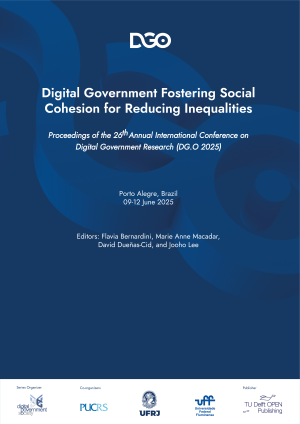
Digital Government Fostering Social Cohesion for Reducing Inequalities: Proceedings of the 26th Annual International Conference on Digital Government Research (DG.O 2025)

Authors

Flavia Bernardini (ed)
Department of Computer Science, Institute of Computing, Fluminense Federal University, Brazil
https://orcid.org/0000-0001-8801-827X
Marie Anne Macadar (ed)
COPPEAD Graduate School of Business, Federal University of Rio de Janeiro, Brazil
https://orcid.org/0000-0003-2744-5352
David Dueñas-Cid (ed)
Department of Management in Networked and Digital Societies, Kozminski University, Poland
https://orcid.org/0000-0002-0451-4514
Jooho Lee (ed)
College of Public Affairs and Community Service, University of Nebraska at Omaha, USA
https://orcid.org/0000-0001-8425-3491

Keywords:

Digital Government Transformation, Digital Governance & GovTech, Artificial Intelligence & Data Policy, Smart Cities & Infrastructure, Digital Democracy & Social Inclusion

Synopsis

This volume presents the Proceedings of the 26th Annual International Conference on Digital Government Research (DG.O 2025), a landmark event marking the conference's first edition in South America, hosted in Porto Alegre, Brazil. Bringing together leading scholars and practitioners from 32 countries, this book explores the critical intersections of public administration, technological innovation, and civic engagement. It includes the full versions of the 119 papers presented over four days across 24 thematic tracks, chaired by 63 colleagues. Many served in multiple roles, reflecting the dedication and collaborative spirit that characterize our community. Together, these efforts ensured both the scientific quality and the intellectual diversity of the program. 

The theme of DG.O 2025, Digital Government Fostering Social Cohesion for Reducing Inequalities, was especially relevant in the Brazilian context and aligned with ongoing international discussions. More than a technological endeavor, digital government represents a powerful means of addressing long-standing social and economic inequalities. In societies characterized by unequal opportunities, fostering social cohesion remains both a pressing challenge and a shared objective. The experiences of Brazil and Latin America highlight the value of inclusive approaches that strengthen participation, trust, resilience, and a sense of belonging. This perspective was reflected throughout the conference program, with tracks and sessions addressing, among other topics:

• Artificial Intelligence, Algorithmic Accountability, and Ethics in Government
• Data-Driven Public Policy, Open Data Ecosystems, and Digital Platforms
• Digital Democracy, E-Participation, and Public Engagement
• Smart Cities, Sustainable Governance, and Urban Social Cohesion
• GovTech, Cybersecurity, Trust, and Digital Public Infrastructure

This volume serves as an interesting resource for researchers, policymakers, and public administrators seeking actionable strategies to leverage digital transformation to build more inclusive, trustworthy, and resilient societies.


Flavia Bernardini, Fluminense Federal University, Brazil
Marie Anne Macadar, Federal University of Rio de Janeiro, Brazil
David Duenas Cid, Kozminski University, Poland
Jooho Lee, PhD, University of Nebraska at Omaha, USA
DG.O 2025 Program Co-Chairs

Downloads
Download data is not yet available.

Author Biographies

Flavia Bernardini, Department of Computer Science, Institute of Computing, Fluminense Federal University, Brazil

Dr. Flavia Bernardini is an Associate Professor at the Institute of Computing, Federal Fluminense University (UFF), Brazil, for more than 15 years. Her main research agenda is to develop computational artifacts for public service delivery using open data and AI. In this theme, she coordinates the Data for Citizenship Center (D4C), has led funded projects, co-authored numerous academic papers, and supervised doctoral students. She coordinates the Special Committee on Digital Government of the Brazilian Computer Society. She has served on major conference program committees, including DG.O and IFIP EGOV, and was the co-Program Chair for DG.O in 2024, 2025, and 2026.

Marie Anne Macadar, COPPEAD Graduate School of Business, Federal University of Rio de Janeiro, Brazil

Dr. Marie Anne Macadar is an Associate Professor of Management Information Systems and the Associate Dean of International Affairs at the COPPEAD Graduate School of Business, Federal University of Rio de Janeiro (UFRJ) in Brazil. She is a long-standing reviewer and co-chair of DG.o, EGOV, ICEGOV, and Conf-IRM conferences, and a regular reviewer for leading national and international journals in her field. Her research interests include Digital Government, Smart Cities, Electronic Participation, Citizen Engagement, and ICT for Development. More recently, she has been focusing her research on culture and sustainable urban development in smart cities.

David Dueñas-Cid, Department of Management in Networked and Digital Societies, Kozminski University, Poland

Dr. Hab. David Dueñas-Cid is an Associate Professor and Director of the Public Sector Data-Driven Technologies Research Centre at Kozminski University. He serves as Secretary of the Digital Government Society (2026–2028), General Chair of the E-Vote-ID Conference, and Emeritus President of the Digital Sociology WG 10 at the International Sociological Association. His research centers on internet voting, digital democracy, and trust in e-governance systems. A widely published author in journals like Government Information Quarterly, his recent work investigates electoral technologies, technological trust, and digital participation.

Jooho Lee, College of Public Affairs and Community Service, University of Nebraska at Omaha, USA

Dr. Jooho Lee is a professor at School of Public Administration and a Co-director of Digital Governance and Analytics Lab at University of Nebraska, Omaha. Areas of his research interest include public management with an emphasis on information and communication technology use in public organizations and the application of social network theories in public management issues such as interagency and interorganizational collaboration. His research has appeared in public administration and electronic government journals such as Public Administration Review, Public Administration, Public Management Review, Policy Studies Journal, Government Information Quarterly, American Review of Public Administration, and Administration and Society.

Blue background with DG.O logo and text

Downloads

Published

July 13, 2026

Data Availability Statement

Each paper in these proceedings includes its own data access policy, funding statement, and statement regarding the use of artificial intelligence (AI).


License

Creative Commons License

This work is licensed under a Creative Commons Attribution 4.0 International License.

Details about this monograph

ISBN-13 (15)

978-94-6518-384-8

Publication date (01)

2026-07-13

How to Cite

Bernardini, F., Macadar, M. A., Dueñas-Cid, D., & Lee, J. (Eds.). (2026). Digital Government Fostering Social Cohesion for Reducing Inequalities: Proceedings of the 26th Annual International Conference on Digital Government Research (DG.O 2025). TU Delft OPEN Books. https://doi.org/10.59490/mt.264