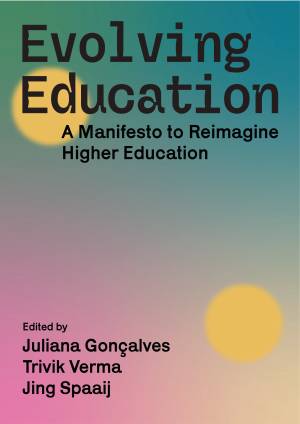
Evolving Education: A Manifesto to Reimagine Higher Education
Keywords:
Open Education, Higher Education, Reflexivity, Transdisciplinary, Equity & Justice, Access & Inclusivity, Pedagogy InnovationSynopsis
Evolving Education is an edited volume of manifestos written by academics, students, and education professionals aiming to reimagine higher education in a context of pressing global challenges like climate change and territorial conflicts, as well as severe austerity measures affecting universities worldwide. At its core, Evolving Education is a call to action - it is a manifesto that dares us to dream big, to think creatively, and to imagine a future where "education is freedom".
The book is not only inspirational and reflective but also provides actionable insights for evolving educators.
Downloads
References
4TU Centre for Engineering Education. (n.d.). Innovating engineering education for tomor¬row's engineer. 4TU Centre for Engineering Education. https://www.4tu.nl/cee
Abdúl-Bahá, Gail, M., & Khan, A. K. (Trans.). (1990). The secret of divine civilization. Bahá'í Publishing Trust.
Aggarwal, A., & Barry, K. (2023). Reflective collaboration model to foster inclusive dialogue. TU Delft. https://www.tudelft.nl/studyclimate/projects/collaborative-learning-1/reflec¬tive-collaboration-model-to-foster-inclusive-dialogue
Akata, Z., Balliet, D., De Rijke, M., Dignum, F., Dignum, V., Eiben, G., Fokkens, A., Grossi, D., Hindriks, K., Hoos, H., Hung, H., Jonker, C., Monz, C., Neerincx, M., Oliehoek, F., Prakken, H., Schlobach, S., Van Der Gaag, L., Van Harmelen, F., … Welling, M. (2020). A Research Agenda for Hybrid Intelli¬gence: Augmenting Human Intellect With Collaborative, Adaptive, Responsible, and Explainable Artificial Intelligence. Computer, 53(8), 18-28. https://doi.org/10.1109/MC.2020.2996587
Akinla, O., Hagan, P., & Atiomo, W. (2018). A systematic review of the literature describing the outcomes of near-peer mentoring programs for first-year medical students. BMC Medical Education, 18, 1-10. https://doi.org/10.1186/s12909-018-1195-1
Akmansoy, V., & Kartal, S. (2014). Chaos Theory and its Application to Education: Mehmet Akif Ersoy University Case. Educational Sciences: Theory & Practice. https://doi.org/10.12738/ estp.2014.2.1928
Alberti, L. B. (1988). On the art of building in ten books (J. Rykwert, Trans.). MIT Press. (Original work published 1485)
Anora, S., & Stirling, A. (2023). Colonial modernity and sustainability transitions: A con-ceptualisation in six dimensions. Environmental Innovation and Societal Transitions, 48. https://doi.org/10.1016/j.eist.2023.100733
Archibald, J. (2008). Indigenous storywork: Educating the heart, mind, body, and spirit. UBC Press. https://doi.org/10.59962/9780774855440
Autor, D., & Price, B. (2003). The Changing Task Composition of the US Labor Market: An Up¬date of Autor, Levy, and Murnane. https://economics.mit.edu/sites/default/files/publications/ the%20changing%20task%20comp%202013.pdf
Avermaete, T., & Gosseye, J. (2023). Urban design in the 20th century: A history. gta Verlag.
Awan, N., Schneider, T., & Till, J. (2011). Spatial agency: Other ways of doing architec¬ture. Routledge.
Bain, A. L., & Podmore, J. A. (2023). Rainbow infrastruggles: The infrapolitics of LGBTQ2S surplus visibility in suburban infrastructure. Journal of Urban Affairs, 1-23. https://doi.org/10.1080/07352166.2023.2192938
Balkir, Z., Alniacika, U., & Apaydın, E. (2011). Fuzzy logic in legal education. Turkish Online Journal of Distance Education, 12, 60-69.
Barabási, A.-L. (2011). The network takeover. Nature Physics, 8(1), 14-16. https://doi. org/10.1038/nphys2188
Barendregt, L., Bendor, R., & van Eekelen, B. (2024). Teaching for transformation: Lessons from critical pedagogy for design futures education. Journal of Futures Studies, 28(4), 123- 128.
Barnett, R. (2018). The ecological university. Routledge. https://doi.org/10.4324/9781315194899
Baron, J. (2012). The point of normative models in judgment and decision making. Frontiers in Psychology, 3.https://doi.org/10.3389/fpsyg.2012.00577
Bauman, Z. (2000). Liquid modernity. Polity.
BBC (2025). Email demands US government workers report DEI programmes. By Kayla Epstein and Brajesh Upadhyay. https://www.bbc.com/news/articles/c78wn5qg3nyo
Bell, F. (2011). Connectivism: Its Place in Theory-Informed Research and Innovation in Technology-Enabled Learning. International Review of Research in Open and Distributed Learning, 12(3), 98-118. https://doi.org/10.19173/irrodl.v12i3.902
Bennett, M. J. (1986). A developmental approach to training for intercultural sensitivity. In-ternational Journal of Intercultural Relations, 10(2), 179-196. https://doi.org/10.1016/0147- 1767(86)90005-2
Bevis, T. B. (2019). The notion of universities. In A world history of higher education ex¬change (pp. 35-53). https://doi.org/10.1007/978-3-030-12434-2_2
Bhatti, Y., Khilji, S.E., & Basu, R. (2013). Frugal Innovation. In S. E. Khilji & C. Rowley (Eds.), Glo-balization, change and learning in South Asia (pp.123-145). Chandos Publishing. https://doi.org/10.1016/B978-0-85709-464-3.50007-6
Biesta, G. (2021). World-centred education: A view for the present. Routledge. https://doi.org/10.4324/9781003098331
Biesta, G. J. J. (2010). Good education in an age of measurement: Ethics, politics, democra¬cy. Routledge. https://archive.org/details/goodeducationina0000bies
Biggs, J. (n.d.). Constructive alignment in university teaching. HERDSA Review of Higher Educa-tion, 1. Retrieved January 28, 2025, from https://www.tru.ca/__shared/assets/Constructive_ Alignment36087.pdf
Biggs, J., & Tang, C. S. (with Society for Research into Higher Education). (2011). Teaching for quality learning at university: What the student does (4th edition). McGraw-Hill/Society for Research into Higher Education/Open University Press.
BIOHM. (n.d.). BIOHM: Regenerative biotechnologies. https://www.biohm.co.uk/
Blondel, J.-F. (1771-1777). Cours d'architecture ou traité de la décoration, distribution & construction des bâtiments(Vols. 1-6). Paris.
Boud, D., & Bearman, M. (2022). The assessment challenge of social and collaborative learn¬ing in higher education. Educational Philosophy and Theory, 56(5), 459-468. https://doi.or g/10.1080/00131857.2022.2114346
Brakels, J., van der Meulen, S., Andernach, T., Thomas, N., & Penny, G. (2024). Vision on ed-ucation. TU Delft.
Breck Dumas, B. S. (2025, January 7). Elon Musk applauds Zuckerberg's move end¬ing fact-checking on Facebook, Instagram [Text article]. FOXBusiness. https://www. foxbusiness.com/politics/elon-musk-applauds-zuckerbergs-move-ending-fact-checking-facebook-instagram
Britannica, The Editors of Encyclopaedia. (2025, January 30). University. Encyclopedia Britannica. https://www.britannica.com/topic/university
Brundiers, K., Barth, M., Cebrián, G., Cohen, M., Diaz, L., Doucette-Remington, S., Dripps, W., Habron, G., Harré, N., Jarchow, M., Losch, K., Michel, J., Mochizuki, Y., Rieckmann, M., Parnell, R., Walker, P., & Zint, M. (2021). Key competencies in sustainability in higher education-To¬ward an agreed-upon reference framework. Sustainability Science, 16(1), 13-29. https://doi. org/10.1007/s11625-020-00838-2
Brünig, L., Kahrass, H., & Salloch, S. (2024). The concept of intersectionality in bioethics: A systematic review. BMC Medical Ethics, 25(1). https://doi.org/10.1186/s12910-024-01057-5
Buchanan, P. (2018, October). Reweaving webs of relationships. e-flux Architec¬ture. https://www.e-flux.com/architecture/overgrowth/221630/reweaving-webs-of-rela¬tionships/
Burnard, P., Ross, V., Minors, H. J., Powell, K., Dragovic, T., & Mackinlay, E. (2017). Build¬ing interdisciplinary and intercultural bridges: Where practice meets research and theo¬ry. BIBACC Publishing.
Butler, J. (2002). Gender trouble. Routledge. https://doi.org/10.4324/9780203902752
Cacioppo, J. T., & Petty, R. E. (1982). The Need for Cognition. Journal of Personality and Social Psychology, 42(1), 116-131. https://doi.org/10.1037/0022-3514.42.1.116
Cacioppo, J. T., Petty, R. E., Feinstein, J. A., & Jarvis, W. B. G. (1996). Dispositional Differences in Cognitive Motivation: The Life and Times of Individuals Varying in Need for Cognition. Psycholog-ical Bulletin, 119(2), 197. https://doi.org/10.1037/0033-2909.119.2.197
Candy, S. (2015). The thing from the future. In A. Curry (Ed.), The APF methods antholo¬gy (pp. 18-21). Association of Professional Futurists.
Carroll, R. (2011). In search of a vocabulary of embodiment. Body, Movement and Dance in Psychotherapy, 6(3), 245-257. https://doi.org/10.1080/17432979.2011.617132
Chin, C., & Chia, L.-G. (2006). Problem-Based Learning: Using Ill-Structured Problems in Biology Project Work. Science Education, 90(1), 44-67. https://doi.org/10.1002/sce.20097
Chorus, C. (2025). Boy, there is work to be done [Online post]. https://www.linkedin.com/ posts/caspar-chorus-492b64194_boy-there-is-work-to-be-done-i-just-read-activity- 7283129401087590401-8pRL
Chung, W. C. (2019). The praxis of product design in collaboration with engineering. Springer International Publishing. https://doi.org/10.1007/978-3-319-95501-8
Clegg, S., Loosemore, M., Walker, D., van Marrewijk, A., & Sankaran, S. (2023). Construction-cultures: Sources, signs, and solutions of toxicity. In S. Addyman & H. Smyth (Eds.), Con¬struction project organising (pp. 3-17). Wiley-Blackwell. http://www.scopus.com/inward/ record.url?scp=85147917310&partnerID=8YFLogxK https://doi.org/10.1002/9781119813798.ch1
Cokely, E. T., Feltz, A., Ghazal, S., Allan, J. N., Petrova, D., & Garcia-Retamero, R. (2018). Skilled Deci¬sion Theory: From Intelligence to Numeracy and Expertise. In K. A. Ericsson, R. R. Hoffman, A. Koz¬belt, & A. M. Williams (Eds.), The Cambridge Handbook of Expertise and Expert Performance (2nd ed., pp. 476-505). Cambridge University Press. https://doi.org/10.1017/9781316480748.026
Collini, S. (2018). Speaking of universities. Verso Books.
Colomina, B. (2014). Manifesto architecture: The ghost of Mies. Sternberg Press.
Cope, B., & Kalantzis, M. (2015). The things you do to know: An introduction to the pedagogy of multiliteracies. In B. Cope & M. Kalantzis (Eds.), A pedagogy of multiliteracies: Learning by design (pp. 1-36). Palgrave Macmillan UK. https://doi.org/10.1057/9781137539724_1
Corbo, L., Kraus, S., Vlačić, B., Dabić, M., Caputo, A., & Pellegrini, M. M. (2023). Coopetition and innovation: A review and research agenda. Technovation, 122, 102624. https://doi. org/10.1016/j.technovation.2023.102624
Cormier, D. (2024). Learning in a time of abundance: The community is the curricu¬lum. Johns Hopkins University Press.
Cranton, P. (2006). Fostering authentic relationships in the transformative classroom. New Directions for Adult and Continuing Education, 2006(109), 5-13. https://doi.org/10.1002/ ace.203
Cranton, P., & Carusetta, E. (2004). Developing authenticity as a transformative process. Jour¬nal of Transformative Education, 2(4), 276-293. https://doi.org/10.1177/1541344604267898
Creely, E. (2010). Method(ology), pedagogy and praxis: A phenomenology of the pre-per¬formative training regime of Phillip Zarrilli. Theatre, Dance and Performance Training, 1(2), 214-228. https://doi.org/10.1080/19443927.2010.505000
Crenshaw, K. (1991). Mapping the margins: Intersectionality, identity politics, and violence against women of color. Stanford Law Review, 43(6), 1241. https://doi.org/10.2307/1229039
Crenshaw, K. (2018). Demarginalizing the intersection of race and sex: A black feminist critique of antidiscrimination doctrine, feminist theory, and antiracist politics [1989]. In K. Bartlett (Ed.), Feminist legal theory: Readings in law and gender (pp. 57-80). https://doi.org/10.4324/9780429500480-5
Croskerry, P. (2003). The Importance of Cognitive Errors in Diagnosis and Strategies to Minimize Them: Academic Medicine, 78(8), 775-780. https://doi.org/10.1097/00001888-200308000- 00003
Cuff, D. (1992). Architecture: The story of practice. MIT Press.
D'Souza, R. (2024). Understanding Heutagogy: A New "Gogy." Journal of Research Initiatives, 8(4).
Da Costa Junior, J., Diehl, J. C., & Snelders, D. (2019). A framework for a systems design approach to complex societal problems. Design Science, 5, e2. https://doi.org/10.1017/ dsj.2019.2
Damhof, L., Kazemier, E., Gulmans, J., Cremers, P., & Beenen, P. (2020). Anticipation for emer-gence: Defining, designing and refining futures literacy in higher education. In Humanistic futures of learning: Perspectives from UNESCO Chairs and UNITWIN Networks (pp. 168-171). UNESCO.
Daneshpour, H., & Kwegyir-Afful, E. (2022). Analysing transdisciplinary education: A scoping review. Science & Education, 31(4), 1047-1074. https://doi.org/10.1007/s11191-021-00277-0
Daniels, M., Carbone, A., Hauer, A., & Moore, D. (2007). Panel-Ill-structured Problem Solving in En¬gineering Education. 2007 37th Annual Frontiers In Education Conference-Global Engineering: Knowledge Without Borders, Opportunities Without Passports, F3F-1. https://doi.org/10.1109/FIE.2007.4418187
David, L., Vassena, E., & Bijleveld, E. (2024). The Unpleasantness of Thinking: A Meta-Analyt¬ic Review of the Association between Mental Effort and Negative Affect. Psychological Bulle¬tin. https://doi.org/10.1037/bul0000443
Davies, W. K., & Longworth, N. (2014). Lifelong Learning. Taylor and Francis. https://doi.org/10.4324/9781315041834
Davis, E. J., Smith, T. J., & Leflore, D. (2008). Chaos in the classroom: A new theory of teaching and learning. Carolina Academic Press.
de Sousa Santos, B. (2019). Decolonizing the university. In B. de Sousa Santos & M. Mene¬ses (Eds.), Knowledges born in the struggle: Constructing the epistemologies of the Global South (pp. 219-239). https://doi.org/10.4324/9780429344596
Deamer, P. (2018). Architecture and labor: The architectural lobby and the fight for fair prac¬tice. Architectural Design, 88(5), 78-85. https://doi.org/10.1002/ad.2296
Deardorff, D. K. (2006). Identification and assessment of intercultural competence as a stu¬dent outcome of internationalization. Journal of Studies in International Education, 10(3), 241-266. https://doi.org/10.1177/1028315306287002
Deardorff, D. K. (2020). Manual for developing intercultural competencies: Story circles. Taylor & Francis. https://doi.org/10.4324/9780429244612
Deardorff, D. K. (Ed.). (2009). The Sage handbook of intercultural competence. Sage. https://doi.org/10.4135/9781071872987
Deloria, V., Jr. (2001). Traditional technology. In V. Deloria, Jr. & D. Wildcat (Eds.), Power & place: Indian education in America. Fulcrum Resources. Should be: Deloria, V., Jr. (2001). Traditional technology. In V. Deloria, Jr. & D. Wildcat (Eds.), Power & place: Indian education in America (pp. 12-17). Fulcrum Resources.
DeTombe, D. (2015). Handling societal complexity: A study of the theory of the methodology of societal complexity and the COMPRAM methodology. Springer. https://doi.org/10.1007/978-3-662-43917-3
Deutscher Ethikrat. (2023). Interculturality. Deutscher Ethikrat. https://www.ethikrat.org/ en/topics/medicine-and-health/interculturality/
DiSCProfile. (n.d.). DiSC styles. https://www.discprofile.com/disc-styles
Dorst, K., Kaldor, L., Klippan, L., & Watson, R. (2016). Designing for the common good. BIS Publishers.
Downes, S. (2012). Connectivism and connectivist knowledge: Essays on meaning and learning networks.
Downes, S. (2022). Connectivism. Asian Journal of Distance Education, 17(1). https://files.eric. ed.gov/fulltext/EJ1350294.pdf
Dressel, P. L. (1971). Values cognitive and affective. The Journal of Higher Education, 42(5), 400-405. https://doi.org/10.1080/00221546.1971.11778644
Dumitru, D., Bigu, D., Elen, J., Jiang, L., Railienė, A., Penkauskiene, D., Papathanasiou, I., Tsaras, K., Fradelos, E., Ahern, A., McNally, C., O'Sullivan, J., Verburgh, A., Jarosova, E., Lorencová, H., Poce, A., Agrusti, F., Re, M., Puig, B., & Palaigeorgiou, G. (2018). A European Collection of the Crit-ical Thinking Skills and Dispositions Needed in Different Professional Fields for the 21st Centu¬ry. [Technical Report].
Dutch Research Council. (2024a). NWO grant rules. https://www.nwo.nl/sites/nwo/files/ media-files/NWO%20Grant%20Rules%20%282024%29_0.pdf
Dutch Research Council. (2024b). NWO: Budget cuts hit the Netherlands as a country of knowledge. https://www.nwo.nl/en/news/nwo-budget-cuts-hit-the-netherlands-as-a-country-of-knowledge
Edgcomb, M. R., Crowe, H. A., Rice, J. D., Morris, S. J., Wolffe, R. J., & McConnaughay, K. D. (2010). Peer and near-peer mentoring: Enhancing learning in summer research pro¬grams. Council on Undergraduate Research Quarterly, 31(2).
Engineers Without Borders UK. (2025, September 10). Engineering for People lands in Bir-mingham. https://www.ewb-uk.org/design-challenge-lands-in-birmingham
Engineers Without Borders UK. (n.d.). What is global responsibility? Explore the four prin¬ciples of global responsibility and why we urgently need to reimagine engineering's role in society. https://www.ewb-uk.org/what-is-global-responsibility
Escobar, A. (2017). Designs for the pluriverse: Radical interdependence, autonomy, and the making of worlds. Duke University Press. https://doi.org/10.1215/9780822371816
Espinosa, A., Harnden, R., & Walker, J. (2008). A complexity approach to sustainability: Staf¬ford Beer revisited. European Journal of Operational Research, 187(2), 636-651. https://doi. org/10.1016/j.ejor.2007.03.025
Espinosa, P. H., Persaud, S., & Giaccardi, E. (2022). MYRUBRIC, a co-creative journey to ac¬tivate resilient learning communities. DS 117: Proceedings of the 24th International Con¬ference on Engineering and Product Design Education (E&PDE 2022), London South Bank University (8th-9th September 2022). https://doi.org/10.35199/epde.2022.124
Euronews. (2024, December 24). European political landscape shifts right in 2024. By Gregoire Lory & Amandine Hess. https://www.euronews.com/my-europe/2024/12/24/eu¬ropean-political-landscape-shifts-right-in-2024-as-far-right-gains-ground
European Research Council. (2012). Guide for ERC grant holders. https://erc.europa.eu/ sites/default/files/document/file/ERC_Guide_ERC_Grant_Holders.pdf
Evans, C., & Center for Assessment. (2020). Measuring student success skills: A review of the literature on collaboration. Center for Assessment. https://files.eric.ed.gov/fulltext/ ED607774.pdf
Ewing, S. (2011). Introduction. In S. Ewing, J. M. McGowan, C. Speed, & V. C. Bernie (Eds.), Ar-chitecture and field/work (pp. 1-3). Routledge. https://doi.org/10.1093/acprof:oso/9780199732678.003.0006
Facer, K. (2016). Using the Future in Education: Creating Space for Openness, Hope and Novelty. In H. E. Lees & N. Noddings (Eds.), The Palgrave International Handbook of Alternative Educa¬tion (pp. 63-78). Palgrave Macmillan UK. https://doi.org/10.1057/978-1-137-41291-1_5 https://doi.org/10.1057/978-1-137-41291-1_5
Fakhredin, F. (2025). Boy, there is work to be done [Reply comment; Online post]. https:// www.linkedin.com/feed/update/urn:li:activity:7283129401087590401?commentUrn=urn %3Ali%3Acomment%3A%28activity%3A7283129401087590401%2C72831345548553420 80%29&dashCommentUrn=urn%3Ali%3Afsd_comment%3A%287283134554855342080% 2Curn%3Ali%3Aactivity%3A7283129401087590401%29
FNV, AOb, & CNV Trade Unions. (2025). Onderzoek sociale veiligheid en leider¬schap TU Delft. https://www.fnv.nl/getmedia/1eb9374b-fdbd-48aa-8925-a16daab¬4c410/20250512-Onderzoek-sociale-veiligheid-en-leiderschap-TU-Delft.pdf
Fosch-Villaronga, E., & Malgieri, G. (2024). Queering the ethics of AI. In Handbook on the ethics of artificial intelligence (pp. 301-315). Edward Elgar Publishing. Should be: Fosch-Vil¬laronga, E., & Malgieri, G. (2024). Queering the ethics of AI. In D. J. Gunkel (Ed.), Handbook on the ethics of artificial intelligence (pp. 301-315). Edward Elgar Publishing. https://doi.org/10.4337/9781803926728.00026
Foucault, M. (2003). The order of things: An archaeology of the human sciences. Routledge.
Fraser, N. (2000). Rethinking recognition. New Left Review, 3, 107-120. https://doi.org/10.64590/pup
Fraser, N. (2010). Scales of justice: Reimagining political space in a globalizing world. Co¬lumbia University Press.
Freire, P. (1970). Pedagogy of the oppressed. Bloomsbury Academic.
Freire, P. (1970). Pedagogy of the oppressed. Herder and Herder.
Freire, P. (2005). Pedagogy of the oppressed (M. B. Ramos, Trans.). Continuum International. (Original work published 1970)
Freire, P. (2005). Pedagogy of the oppressed (M. B. Ramos, Trans.; 30th anniversary ed.). The Continuum International Publishing Group. (Original work published 1970)
Freire, P. (2018). Pedagogy of the oppressed. Bloomsbury. https://doi.org/10.4324/9780429269400-8
Frese, M., Gielnik, M. M., & Mensmann, M. (2016). Psychological training for entrepreneurs to take action: Contributing to poverty reduction in developing countries. Current Directions in Psychological Science, 25(3), 196-202. https://doi.org/10.1177/0963721416645518
Fudenberg, D., & Tirole, J. (1991). Game theory. MIT Press.
Galvagno, M., & Dalli, D. (2014). Theory of value co-creation: A systematic literature re¬view. Managing Service Quality, 24(6), 643-683. https://doi.org/10.1108/MSQ-09-2014- 0187
Geniusz, W. M. (2009). Our knowledge is not primitive: Decolonizing botanical Anishinaabe teachings. Syracuse University Press. https://doi.org/10.1353/book.109810
Gheza, D., Kool, W., & Pourtois, G. (2023). Need for Cognition Moderates the Relief of Avoiding Cognitive Effort. PLOS ONE, 18(11), e0287954. https://doi.org/10.1371/journal.pone.0287954
Giddens, A. (1990). The consequences of modernity. Polity Press & Blackwell Publishers.
Gielnik, M. M., Uy, M. A., Funken, R., & Bischoff, K. M. (2017). Boosting and sustaining passion: A long-term perspective on the effects of entrepreneurship training. Journal of Business Venturing, 32(3), 334-353. https://doi.org/10.1016/j.jbusvent.2016.12.001
Gigerenzer, G., & Gaissmaier, W. (2011). Heuristic Decision Making. Annual Review of Psychology, 62(1), 451-482. https://doi.org/10.1146/annurev-psych-120709-145346
Goh, Z., Eva, N., Kiazad, K., Jack, G. A., De Cieri, H., & Spreitzer, G. M. (2022). An integrative multilevel review of thriving at work: Assessing progress and promise. Journal of Organiza¬tional Behavior, 43(2), 197-213. https://doi.org/10.1002/job.2571
Goldie, J. G. S. (2016). Connectivism: A knowledge learning theory for the digital age? Medical Teacher, 38(10), 1064-1069. https://doi.org/10.3109/0142159X.2016.1173661
Goncalves, J. E. (2026). Climate change as a crisis of recognition: Prefigurative politics of socio-ecological movements for food sovereignty in Brazil. In S. Sareen & S. Juhola (Eds.), Societal transitions to sustainability: The prefigurative politics of present transfor¬mation. Palgrave-MacMillan.
Gonçalves, J.E. (2025). A crisis of imagination or a crisis of recognition? The role of prefigu¬rative planning in fostering alternative imaginaries. In R. Rocco, C. Newton, & J. Gonçalves (Eds.), A Manifesto for the Just City: Volume 4 (pp. 14-23). TU Delft OPEN Publishing.
Gordon, I. J., Bawa, K., Bammer, G., Boone, C., Dunne, J., Hart, D., Hellmann, J., Miller, A., New, M., Ometto, J., Pickett, S., Wendorf, G., Agrawal, A., Bertsch, P., Campbell, C. D., Dodd, P., Janetos, A., Mallee, H., & Taylor, K. (2019). Forging future organizational leaders for sustainability science. Nature Sustainability, 2(8), 647-649. https://doi.org/10.1038/s41893-019-0357-4
Government of the Netherlands. (2024). Aiming for a balanced internationalisation of universities and universities of applied sciences. https://www.government.nl/latest/ news/2024/05/13/aiming-for-a-balanced-internationalisation-of-universities-and-uni¬versities-of-applied-sciences
Grant, J. (2021). The new power university: The social purpose of higher education in the 21st century. Pearson UK.
Gravett, K., Taylor, C. A., & Fairchild, N. (2021, October 21). Pedagogies of mattering: Re-conceptualising relational pedagogies in higher education. Teaching in Higher Educa¬tion, 29(2), 388-403. https://doi.org/10.1080/13562517.2021.1989580
Gregersen-Hermans, J. (2017). Intercultural competence development in higher education. In D. Deardorff & L. Arasaratnam-Smith (Eds.), Intercultural competence in higher educa¬tion (pp. 67-82). Routledge. https://doi.org/10.4324/9781315529257-7
Griffith, R. L., Wolfeld, L., Armon, B. K., Rios, J., & Liu, O. L. (2016). Assessing intercultural competence in higher education: Existing research and future directions. ETS Research Report Series, 2016(2), 1-44. https://doi.org/10.1002/ets2.12112
Guillén-Yparrea, N., & Ramírez-Montoya, M. S. (2023). Intercultural competencies in higher education: A systematic review from 2016 to 2021. Cogent Education, 10(1), 2167360. https:// doi.org/10.1080/2331186X.2023.2167360
Hall, D., & Buzwell, S. (2012). The problem of free-riding in group projects: Looking beyond social loafing as reason for non-contribution. Active Learning in Higher Education, 14(1), 37-49. https://doi.org/10.1177/1469787412467123
Harasim, L. (2012). Learning theory and online technologies. Routledge. https://doi.org/10.4324/9780203846933
Haraway, D. (2016). Staying with the trouble: Making kin in the Chthulucene. Duke Univer¬sity Press. https://doi.org/10.2307/j.ctv11cw25q
Haraway, D. J. (2016). Staying with the trouble. Duke University Press. https://doi. org/10.1215/9780822373780
Harris, J., Brown, V. A., & Russell, J. (Eds.). (2010). Tackling wicked problems: Through the transdisciplinary imagination. Earthscan. https://doi.org/10.4324/9781849776530
Harvey, D. (2014). Seventeen contradictions and the end of capitalism. Oxford University Press.
Henderson, J. S. Y. (2000). Empowering Aboriginal thought. In M. Battiste (Ed.), Reclaiming Indigenous voice and vision(pp. 248-279). UBC Press.
Hermsen, P., Rooij, R., Rijnbeek, G., & Adrichem, T. (2022). Reflection in engineering educa¬tion: White paper '100 DAYS OF… REFLECTION'. Delft University of Technology.
Hermsen, P., Rooij, R., Rijnbeek, G., Adrichem, T., & TU Delft Teaching Academy. (2022). Re¬flection in engineering education: White paper '100 DAYS OF… REFLECTION' [Slide show]. https://filelist.tudelft.nl/TUDelft/Thema-sites%20TU%20Delft/Teaching%20 Academy/Themes/Reflective%20Engineer/Whitepaper/100Days%20of%20Reflection%20 in%20Engineering%20Education.pdf
Hoffman, E., & Verdooren, A. (2018). Diversity competence [Edwin Hoffman & Arjan Verdooren]. Managementboek.nl. https://www.managementboek.nl/boek/9789046905982/diversity-competence-edwin-hoffman
Hoffman, J., Pelzer, P., Albert, L., Béneker, T., Hajer, M., & Mangnus, A. (2021). A futuring approach to teaching wicked problems. Journal of Geography in Higher Education, 45(4), 576-593. https://doi.org/10.1080/03098265.2020.1869923
Hofman, A., Brinkhuis, M., Bolsinova, M., Klaiber, J., Maris, G., & Van Der Maas, H. (2020). Tracking with (Un)Certainty. Journal of Intelligence, 8(1), 10. https://doi.org/10.3390/jintelligence8010010
Holck, L., Muhr, S. L., & Villesèche, F. (2016). Identity, diversity and diversity manage¬ment. Equality, Diversity and Inclusion: An International Journal, 35(1), 48-64. https://doi. org/10.1108/EDI-08-2014-0061
Hoogeveen, J., & Rossi, M. (2019). Transforming education outcomes in Africa: Learning from Togo (p. 103). Springer Nature. https://doi.org/10.1007/978-3-030-12708-4
Hora, S. C. (1996). Aleatory and epistemic uncertainty in probability elicitation with an example from hazardous waste management. Reliability Engineering & System Safety, 54(2-3), 217-223. https://doi.org/10.1016/S0951-8320(96)00077-4
Horn, A., Scheffelaar, A., Urias, E., & Zweekhorst, M. B. M. (2022). Training students for complex sustainability issues: A literature review on the design of inter- and transdisci¬plinary higher education. International Journal of Sustainability in Higher Education, 24(1), 1-27. https://doi.org/10.1108/IJSHE-03-2021-0111
Hornborg, A. (2009). Zero-sum world: Challenges in conceptualizing environmen¬tal load displacement and ecologically unequal exchange in the world system. In¬ternational Journal of Comparative Sociology, 50(3-4), 237-262. https://doi.org/10.1177/0020715209105141
Hosey, L. (2012). The shape of green: Aesthetics, ecology and design. Island Press. https://doi.org/10.22269/120608
Hrastinski, S. (2008). What is online learner participation? A literature review. Computers & Education, 51(4), 1755-1765. https://doi.org/10.1016/j.compedu.2008.05.005
Hughes, F. (2022, May 12). 'Filthy logics': The architecture of mediocrity [Berlage Keynote Lecture]. https://www.youtube.com/live/tfNfnrcPutU https://doi.org/10.2307/j.ctv2x8v5x2.12
Hughes, F., & Lokko, L. (as told to M. Mollard). (2021, November). A school willing to take risks. The Architectural Review.
Huls, A. (2025, June 20). Innovative engineering project supports Indigenous forest stew¬ardship. York University. https://www.yorku.ca/yfile/2025/06/20/innovative-engineer¬ing-project-supports-indigenous-forest-stewardship/?utm_source=chatgpt.com
Hume, D. (2000). A treatise of human nature. Oxford University Press.
Hunter, W. J., & Benson, G. D. (1997). Arrows in time: The misapplication of chaos theory edu-cation. Journal of Curriculum Studies, 29(1), 87-100. https://doi.org/10.1080/002202797184215
Hurt, M. (2014). Arthur Lessac's embodied actor training. Routledge. https://doi.org/10.4324/9781315851075
Hyyppä, I., Rasa, T., & Laherto, A. (2024). Fostering students' systems thinking through futures education. Frontline Learning Research, 12(2), 27-50. https://doi.org/10.14786/flr.v12i2.1301
Inspectorate of Education. (2024). Onderzoek naar naleving van wet- en regelgeving. https://filelist.tudelft.nl/TUDelft/Actueel/20240216%20Definitief%20rapport%20Onderwi-jsinspectie%20-%20TU%20Delft.pdf
jagatkreasi. (2025). Tree generic color fill icon. Freepik. https://www.freepik.com/icon/ tree_14290552
Jakobi, A. P., & Rusconi, A. (2009). Lifelong Learning in the Bologna Process: European Devel-opments in Higher Education. Compare: A Journal of Comparative and International Education, 39(1), 51-65. https://doi.org/10.1080/03057920801936977
Jiang, D., Dahl, B., & Du, X. (2023). A systematic review of engineering students in inter¬cultural teamwork: Characteristics, challenges, and coping strategies. Education Sciences, 13(6), Article 6. https://doi.org/10.3390/educsci13060540
Jimmy, E., Andreotti, V., & Stein, S. (2019). Towards braiding. Musagetes Foundation.
Jonassen, D. H. (2000). Toward a Design Theory of Problem Solving. Educational Technology Re-search and Development, 48(4), 63-85. https://doi.org/10.1007/BF02300500
Jonassen, D., Strobel, J., & Lee, C. B. (2006). Everyday Problem Solving in Engineering: Les¬sons for Engineering Educators. Journal of Engineering Education, 95(2), 139-151. https://doi. org/10.1002/j.2168-9830.2006.tb00885.x
Jones, P. L. (1969). The failure of basic design. Leonardo, 2(2), 155-160. https://doi.org/10.2307/1572021
Kaijima, M., Stadler, L., & Iseki, Y. (2018). Architectural ethnography. TOTO Publishing.
Kamp, A. (2016). Engineering education in the rapidly changing world: Rethinking the vision for higher engineering education. TU Delft, Faculty of Aerospace Engineering.
Kazemier, E. M., Damhof, L., Gulmans, J., & Cremers, P. H. M. (2021). Mastering futures literacy in higher education: An evaluation of learning outcomes and instructional design of a faculty devel-opment program. Futures, 132, 102814. https://doi.org/10.1016/j.futures.2021.102814
Kellam, N., & Jennings, M. (2021). Uncovering epistemologies and values of our qualitative engineering education research community: Listening for voices. Studies in Engineering Education, 2(1), 80-99. https://doi.org/10.21061/see.37
Kemp, R. (2012). Embodied acting: What neuroscience tells us about performance. Routledge.
Klaassen, R., van Dijk, M., Hoope, R., & Kamp, A. (2019). Engineer of the future: Envisioning higher engineering education in 2035. TU Delft OPEN Publishing.
Kolb, A., & Kolb, D. (2024). Experiential learning cycle: Things to know about the 8 ALICE & David Kolb experience-based learning systems.
Koning, J., & van Dijk, T. (2024). Rehabilitating utopias: The importance of imagination to confronting our spatial challenges. Planning Practice & Research, 39(1), 136-155. https://doi.org/10.1080/02697459.2021.1954750
Kotcher, J. E., Maibach, E. W., Miller, J., Frumkin, H., & Leiserowitz, A. (2017). Does engage¬ment in advocacy hurt the credibility of scientists? Results from a randomized national sur¬vey experiment. Environmental Communication, 11(3), 415-429. https://doi.org/10.1080/17 524032.2016.1275732
Kumar, R. R. (2017). The effect of collaborative learning on enhancing student achievement: A meta-analysis. https://spectrum.library.concordia.ca/982327/
Kumari, S. (2024). Humanism in education: Fostering student-centered learning through Maslow's and Rogers' theories. International Journal of Research Publication and Reviews, 2582-7421. http://www.ijrpr.com https://doi.org/10.55248/gengpi.5.0724.1911
Lakoff, G., & Johnson, M. (2008). Metaphors we live by. University of Chicago Press.
Lambrechts, W., Ghijsen, P. W., Jacques, A., Walravens, H., Van Liedekerke, L., & Van Pete¬gem, P. (2018). Sustainability segmentation of business students: Toward self-regulated development of critical and interpretational competences in a post-truth era. Journal of Cleaner Production, 202, 561-570. https://doi.org/10.1016/j.jclepro.2018.07.303
Lantz-Deaton, C., & Golubeva, I. (2020). How do we define intercultural competence? In C. Lantz-Deaton & I. Golubeva (Eds.), Intercultural competence for college and university stu¬dents: A global guide for employability and social change(pp. 111-155). Springer Interna¬tional Publishing. https://doi.org/10.1007/978-3-030-57446-8_4
Latour, B. (2004). Why has critique run out of steam? From matters of fact to matters of concern. Critical Inquiry, 30, 225-248. https://doi.org/10.1086/421123
Leeds-Hurwitz, W. (2013). Intercultural competences: Conceptual and operational frame¬work. UNESCO Digital Library. https://unesdoc.unesco.org/ark:/48223/pf0000219768
Lefebvre, H. (1991). The production of space (D. Nicholson-Smith, Trans.). Blackwell. (Original work published 1974)
Lefebvre, H. (2009). Space and state (A. Kowalski et al., Trans.). In N. Brenner & S. Elden (Eds.), Henri Lefebvre: State, space, world (pp. 223-253). University of Minnesota Press.
Leliveld, A., & Knorringa, P. (2018). Frugal innovation and development research. The Eu¬ropean Journal of Development Research, 30, 1-16. https://doi.org/10.1057/s41287-017- 0123-8 https://doi.org/10.1057/s41287-017-0121-4
Leliveld, A., Bhaduri, S., Knorringa, P., & van Beers, C. (2023). Capturing frugal innovation: Introduction to the Handbook on Frugal Innovation. In A. Leliveld, S. Bhaduri, P. Knorrin¬ga, & C. van Beers (Eds.), Handbook on Frugal Innovation (pp. 1-26). Edward Elgar Publish¬ing. https://doi.org/10.4337/9781788118873.00007
Levin, K., Cashore, B., Bernstein, S., & Auld, G. (2012). Overcoming the tragedy of super wick¬ed problems: Constraining our future selves to ameliorate global climate change. Policy Sci¬ences, 45, 123-152. https://doi.org/10.1007/s11077-012-9151-0
Leydens, J. A., & Lucena, J. C. (2017). Engineering justice: Transforming engineering educa¬tion and practice. Wiley. https://doi.org/10.1002/9781118757369
Lindén, J., Ohlin, M., & Brodin, E. M. (2013). Mentorship, supervision and learning experience in PhD education. Studies in Higher Education, 38(5), 639-662. https://doi.org/10.1080/03075079.2011.596526
Lutterbie, J. (2011). Toward a general theory of acting: Cognitive science and perfor¬mance. Palgrave Macmillan.
Lynn, S. K., Wormwood, J. B., Barrett, L. F., & Quigley, K. S. (2015). Decision making from economic and signal detection perspectives: Development of an integrated framework. Frontiers in Psy-chology, 6.https://doi.org/10.3389/fpsyg.2015.00952
Mazzocchi, F. (2019). Scientific research across and beyond disciplines. EMBO Reports. https://doi.org/10.15252/embr.201947682
Mazzucato, M. (2022). Collective value creation: A new approach to stakeholder value. In-ternational Review of Applied Economics, 38(1-2), 43-57. https://doi.org/10.1080/0269217 1.2022.2144149
Mello, L. V., & Wattret, G. (2021). Developing transferable skills through embedding reflection in the science curriculum. Biophysical Reviews, 13(6), 897-903. https://doi.org/10.1007/ s12551-021-00852-3
Messiha, K., Altenburg, T. M., Giné-Garriga, M., Chastin, S., & Chinapaw, M. J. (2025). Enrich¬ing the existing knowledge about co-creation: Identifying dimensions of co-creation using explicit theory in various research fields. Minerva, 1-24. https://doi.org/10.1007/s11024-025-09491-1
Middleton, R. (1959). Jacques François Blondel and the Cours d'Architecture. Journal of the Society of Architectural Historians, 18(4), 140-148. https://doi.org/10.2307/987849
Miraftab, F. (2022). Insurgent practices of hope and care for humane urbanism. In R. Rocco & C. Newton (Eds.), Manifesto for the just city: Volume 2. TU Delft OPEN Publishing.
Moleka, P. (2024). Frugal innovation for inclusive and sustainable development in Afri¬ca. Advanced Research in Economics and Business Strategy, 5(1), 107-117. https://doi. org/10.5281/zenodo.1234567 https://doi.org/10.52919/arebus.v5i1.58
Moore, J. C. (2019). The Middle Ages: 500-1500. In A brief history of universities. Springer. https://doi.org/10.1007/978-3-030-01319-6_2
Morin, E. (2007). Restricted complexity, general complexity. In Worldviews, Science and Us (pp. 5-29). https://doi.org/10.1142/9789812707420_0002
Munro, M. (2018). Principles for embodied learning approaches. South African Theatre Jour¬nal, 31(1), 5-14. https://doi.org/10.1080/10137548.2017.1404435
Murthy, P. N. (2000). Complex societal problem solving: A possible set of methodological criteria. Systems Research and Behavioral Science, 17(1), 73-101. https://doi.org/10.1002/ (SICI)1099-1743(200001/02)17:1<73::AID-SRES200>3.0.CO;2-O https://doi.org/10.1002/(SICI)1099-1743(200001/02)17:1<73::AID-SRES208>3.0.CO;2-I
Netherlands Labour Authority. (2024). Occupational health and safe¬ty special: Research report on psychosocial workload at Dutch universities. https://www.nllabourauthority.nl/publications/reports/2024/05/14/psychosocial-work¬load-at-dutch-universities
Neufert, E. (2019). Architects' data (5th ed., J. Kister, Trans.). Wiley-Blackwell. (Original work published 1936)
Neville Medhora [@nevmed]. (2020, June 15). The "Circle of Influence" concept. [Tweet]. Twitter. https://x.com/nevmed/status/1272348361933369344
Nicolescu, B. (2002). Manifesto of transdisciplinarity. State University of New York Press. https://archive.org/details/manifestooftrans0000nico
Nicolescu, B. (2010). Methodology of transdisciplinarity: Levels of reality, logic of the included middle and complexity. Transdisciplinary Journal of Engineering & Science, 1(1), 19-38. https://doi.org/10.22545/2010/0009
O'Riordan, T., & Lenton, T. (2013). Addressing tipping points for a precarious future. Oxford University Press. https://doi.org/10.5871/bacad/9780197265536.001.0001
OECD. (2022). Does Higher Education Teach Students to Think Critically? (D. Van Damme & D. Zahner, Eds.). OECD. https://doi.org/10.1787/cc9fa6aa-en
Okely, J. (2012). Anthropological practice: Fieldwork and the ethnographic method (1st ed.). Routledge.
Open and Collaborative Science in Development Network (OCSD net). (2025). Open science manifesto. OCSD net. https://ocsdnet.org/manifesto/open-science-manifesto/
Ord, J. (2012). John Dewey and experiential learning: Developing the theory of youth work. Youth & Policy, 108(1), 55-72. https://doi.org/10.1080/09537325.2012.10780745
Oza, P., & Japee, G. (2020, January 20). History of higher education - From ancient to the modern. https://doi.org/10.13140/RG.2.2.14254.46406
Palmer, B., Marra, R. M., Wise, J. C., & Litzinger, T. A. (2000). A Longitudinal Study of Intellectual Development of Engineering Students: What Really Counts in Our Curriculum? 30th Annual Fron-tiers in Education Conference... 2, S3A-2. https://doi.org/10.1109/FIE.2000.896663
Panhofer, H., & Payne, H. (2011). Languaging the embodied experience. Body, Movement and Dance in Psychotherapy, 6(3), 215-232. https://doi.org/10.1080/17432979.2011.572625
Park, M., Leahey, E., & Funk, R. J. (2023). Papers and patents are becoming less disruptive over time. Nature, 613, 138-144. https://doi.org/10.1038/s41586-022-05543-x
Pashby, K. (2015). Conflations, possibilities, and foreclosures: Global citizenship education in a multicultural context. Curriculum Inquiry, 45(4), 345-366. https://doi.org/10.1080/036 26784.2015.1060141 https://doi.org/10.1080/03626784.2015.1064304
Penkauskienė, D., Railienė, A., & Cruz, G. (2019). How Is Critical Thinking Valued by the Labour Market? Employer Perspectives from Different European Countries. Studies in Higher Education, 44(5), 804-815. https://doi.org/10.1080/03075079.2019.1586323
Perkin, H. (2007). History of universities. In J. J. F. Forest & P. G. Altbach (Eds.), Interna¬tional handbook of higher education (pp. 159-205). Springer. https://doi.org/10.1007/978-1-4020-4012-2_10
Perkins, D. N., Farady, M., & Bushey, B. (2012). Everyday Reasoning and the Roots of Intelligence. In J. F. Voss, D. N. Perkins & J. W. Segal (Eds.), Informal Reasoning and Education (pp. 83-106). Routledge.
Perrault, C. (1993). Ordonnance for the five kinds of columns after the method of the an¬cients (I. K. McEwen, Trans.). Getty Center. (Original work published 1683)
Persbureau, H. O. (2024, May 16). This is what the Dutch coalition agreement says about higher education-Delta. https://delta.tudelft.nl/en/article/this-is-what-the-dutch-coali¬tion-agreement-says-about-higher-education
Phillips, E., & Johnson, C. (2022). How to get a PhD: A handbook for students and their su-pervisors (7th ed.). McGraw-Hill Education.
Poli, R. (2010). Steps Toward an Explicit Ontology of the Future. Journal of Futures Studies, 16.
Popescu, V. F., & Pi̇Stol, M. S. (2021). Fuzzy logic expert system for evaluating the activity of uni-versity teachers. International Journal of Assessment Tools in Education, 8(4), 991-1008. https://doi.org/10.21449/ijate.1025690
Pozzoni Architecture. (2023, April 28). Intergenerational design: Bringing communities to¬gether. https://www.pozzoni.co.uk/stories/intergenerational-design-bringing-communi¬ties-together
Promovendi Netwerk Nederland. (2025). Four years of contract, five+ years of work: Fac¬tors hindering and supporting a timely PhD completion. https://doi.org/10.5281/zeno¬do.14946489
Puig de la Bellacasa, M. (2027). Matters of care: Speculative ethics in more than human worlds. University of Minnesota Press.
Rabinow, P. (2007). Reflections on fieldwork in Morocco (2nd ed.). University of California Press.
Racimo, F., Valentini, E., Rijo De León, G., Santos, T. L., Norberg, A., Atmore, L. M., Murray, M., Hakala, S., Appel Olsen, F., Gardner, C. J., & Halder, J. B. (2022). The Role of Life Scientists in the Biospheric Emergency: A Case for Acknowledging Failure and Changing Tactics. Zeno¬do. https://doi.org/10.5281/zenodo.7047049
Rao, B.C. (2022). Frugal engineering. In P. Régnier, D. Frey, S. Pierre, K. Varghese, and P. Wild (Eds.), Handbook of innovation & appropriate technologies for international development(pp. 140-153). Edward Elgar Publishing. https://doi.org/10.4337/9781800885001.00013
Ritchey, T. (2011). Wicked problems-social messes: Decision support modelling with mor-phological analysis (Vol. 17). Springer Science & Business Media. https://doi.org/10.1007/978-3-642-19653-9
Rittel, H. W. J., & Webber, M. M. (1973). Dilemmas in a general theory of planning. Policy Sci¬ences, 4(2), 155-169. https://doi.org/10.1007/BF01405730
Rocco, R. (2023). Manifestos as exercises of hope and care. In R. Rocco & C. Newton (Eds.), A manifesto for the just city: Volume 3 (pp. 8-24). TU Delft OPEN Publising.
Rocco, R., & Newton, C. (2022). A manifesto for the just city: Volume 2 (Vol. 2). TU Delft OPEN Publishing. https://doi.org/10.34641/MG.36
Rocco, R., Newton, C., & Gonçalves, J. (2025). A manifesto for the just city: Volume 4. Delft Open Publishing. https://doi.org/10.59490/mg.142
Rocco, R., Newton, C., D'Alençon, L. M. V., Watt, A. V. D., Babu, G., Tellez, N., Subendran, J., Caradonna, G., Gioia, L. D., & Pessoa, I. T. (2021). A manifesto for the just city. TU Delft OPEN Publishing. https://doi.org/10.34641/mg.14
Rossi, E. L. (2000). Dreams, consciousness, spirit: The quantum experience of self-reflec¬tion and co-creation. Zeig Tucker & Theisen Publishers.
Royal Netherlands Academy of Arts and Sciences. (2025). KNAW: Academische vrijheid in Nederland onder druk. https://www.knaw.nl/nieuws/knaw-academische-vrijheid-neder¬land-onder-druk
Sabet, P. G. P., & Chapman, E. (2023). A window to the future of intercultural competence in tertiary education: A narrative literature review. International Journal of Intercultural Rela¬tions, 96, 101868. https://doi.org/10.1016/j.ijintrel.2023.101868
Savela, T. (2024). Detecting deviance: Exploring a controversy surrounding a rainbow cross¬ing through a Deleuzo-Guattarian lens. Geoforum, 152, 104025. https://doi.org/10.1016/j.geoforum.2024.104025
Schinkel, W., & Van Reekum, R. (2019). Theorie van de kraal: Kapitaal, ras, fascisme. Boom.
Schwarts, S.H. (1992). Universals in the content and structure of values: Theoretical ad¬vances and empirical tests in 20 countries. In M. P. Zanna (Ed.), Advances in experimental social psychology (Vol. 25, pp. 1-65). Academic Press. https://doi.org/10.1016/S0065-2601(08)60281-6
Serlio, S. (1996). Sebastiano Serlio on architecture (V. Hart & P. Hicks, Trans.). Yale University Press. (Original work published 1545)
Shahjahan, R. A., Estera, A. L., Surla, K. L., & Edwards, K. T. (2022). "Decoloniz¬ing" curriculum and pedagogy: A comparative review across disciplines and glob¬al higher education contexts. Review of Educational Research, 92(1), 73-113. https://doi.org/10.3102/00346543211042423
Shapin, S. (2022). Hard science, soft science: A political history of a disciplinary array. His¬tory of Science, 60(3), 1-42. https://doi.org/10.1177/00732753221094739
Shin, N., Jonassen, D. H., & McGee, S. (2003). Predictors of Well-structured and Ill-structured Problem Solving in an Astronomy Simulation. Journal of Research in Science Teaching, 40(1), 6-33. https://doi.org/10.1002/tea.10058
Simpson, L. B. (2014). Land as pedagogy: Nishnaabeg intelligence and rebellious transfor¬mation. Decolonization: Indigeneity, Education & Society.
Snow, C. P. (1959). Two cultures. Science, 130(3373), 419. https://doi.org/10.1126/science.130.3373.419
Sociaal en Cultureel Planbureau. (2022). Arbeidsmarkt in kaart Werkgevers - editie 3. https:// digitaal.scp.nl/arbeidsmarkt-in-kaart-werkgevers-editie-3/
Soja, E. (2010). Seeking spatial justice. University of Minnesota Press. https://doi.org/10.5749/minnesota/9780816666676.001.0001
Soja, E. (2010). The city and spatial justice. In B. Bret, P. Gervais-Lambony, C. Hancock, & F. Landy (Eds.), Justices et injustices spatiales (pp. xx-xx). Presses universitaires de Paris Nanterre. https://doi.org/10.4000/books.pupo.415
Spelt, E., Luning, P., Van Boekel, M., & Mulder, M. (2014). Constructively aligned teaching and learning in higher education in engineering: What do students perceive as contributing to the learning of interdisciplinary thinking? European Journal of Engineering Education, 40(5), 459-475. https://doi.org/10.1080/03043797.2014.987647
Stein, M., Winkler, C., Kaiser, A., & Dierks, T. (2014). Structural brain changes related to bi-lingualism: Does immersion make a difference? Frontiers in Psychology, 5, 1116. https://doi.org/10.3389/fpsyg.2014.01116
Stein, S., Andreotti, V., Suša, R., Amsler, S., Hunt, D., Ahenakew, C., Jimmy, E., Cajkova, T., Valley, W., Cardoso, C., Siwek, D., Pitaguary, B., D'Emilia, D., Pataxó, U., Calhoun, B., & Okano, H. (2020). Gesturing towards decolonial futures: Reflections on our learnings thus far. Nor¬dic Journal of Comparative and International Education (NJCIE), 4(1), 43-65. https://doi. org/10.7577/njcie.3518
Steinert, S. (2023). Philosophy and value. In Interdisciplinary value theory (pp. 67-82). Palgrave Macmillan. https://doi.org/10.1007/978-3-031-10733-7_5
Stuart, M., & Shutt, L. (2019, January 25). From fixed to porous: The permeability of our institutions. Wonkhe. https://wonkhe.com/blogs/from-fixed-to-porous-the-permeabili¬ty-of-our-institutions
Sultana, F. (2021). Critical climate justice. The Geographical Journal, 188(1), 118- 124. https://doi.org/10.1111/geoj.12417
Szacka, L. C., Patteeuw, V., Loorbach, D., & Veenstra, P. (2024). It's about time: The architec¬ture of climate change. Nai010 Publishers.
Tafuri, M. (1976). Architecture and utopia: Design and capitalist development (B. L. La Penta, Trans.). MIT Press.
Tan, D., & Nguyen, M. Q. (2024). Beyond the palimpsest: Traditions and modernity in urban villages of Shenzhen, China. Cities, 151, 105093. https://doi.org/10.1016/j.cities.2024.105093
Tang, M. (2019). Fostering creativity in intercultural and interdisciplinary teams: The VIC¬TORY model. Frontiers in Psychology, 10, 2020. https://doi.org/10.3389/fpsyg.2019.02020
the Design Museum. (2025). More than human. The Design Museum. https://designmuse-um.org/exhibitions/more-than-human
The Institution of Structural Engineers. (2022, November 24). Annual academics' con¬ference 2022. https://www.istructe.org/resources/training/annual-academics-confer¬ence-2022
Till, J. (2005). Lost judgment: From skirting boards to suicide. In EAAE Prize 2003-2005: Writings in Architectural Education (pp. 164-181).
Till, J. (2008). Architecture and contingency. Field, 1(1), 120-135.
Till, J. (2009). Architecture depends (Vol. 55). MIT Press.
Till, J. (2009). Architecture depends. MIT Press.
Tokuhama-Espinosa, T. (2019). The Learning Sciences Framework in Educational Leader¬ship. Frontiers in Education, 4, 136. https://doi.org/10.3389/feduc.2019.00136
Troiani, I. (2017). Academic capitalism in architecture schools: A feminist critique of em-ployability, 24/7 work, and entrepreneurship. In H. Frichot, C. Gabrielsson & H Runting (Eds.), Architecture and feminisms: Ecologies, economies, technologies (pp.170-180). Rout¬ledge. https://doi.org/10.4324/9780203729717
Trowell, M. (2024). The importance of safe, brave and facilitated spaces in student-staff partnerships: Finding a space for compassion. Pastoral Care in Education, 1-22. https://doi. org/10.1080/02643944.2024.2322534
Trujillo, G., Aguinaldo, P. G., Anderson, C., Bustamante, J., Gelsinger, D. R., Pastor, M. J., Wright, J., Márquez-Magaña, L., & Riggs, B. (2015). Near-peer STEM mentoring offers un¬expected benefits for mentors from traditionally underrepresented backgrounds. Perspec¬tives on Undergraduate Research and Mentoring, 4(1).
TU Delft University Graduate School. (2022). Doctoral education competences mod¬el. https://filelist.tudelft.nl/TUDelft/Onderwijs/Opleidingen/PhD/20220301%20DE%20 Competences%20model%202022%20V1.pdf
TU Delft University Graduate School. (2023a). Yearly progress meeting (24 months): Half-way point: Time to look back and define the next steps. https://filelist.tudelft.nl/LR/Onder-zoek/Graduate_School_AE/Documents_and_Links/YPM%20Form%2024%20Months.pdf
TU Delft University Graduate School. (2023b). Yearly progress meeting (36 months): Finaliz¬ing the dissertation: Making sure the thesis is complete within the next 12 months. https:// intranet.tudelft.nl/documents/20147/0/YPM+Form+36+months.pdf/5f0706b4-9174- b5f4-f080-8dddbeceb324
TU Delft University Graduate School. (2023c). Yearly progress meeting (48 months): Ac¬tion needed! Obtaining your doctoral degree is taking longer than expected. https://filel-ist.tudelft.nl/LR/Onderzoek/Graduate_School_AE/Documents_and_Links/YPM%20 Form%2048%20Months.pdf
TU Delft University Graduate School. (2024a). Guidelines for the PhD thesis and competen¬cies of the PhD candidate. https://intranet.tudelft.nl/documents/20147/9319511/Guide-lines+for+the+PhD+Thesis+and+Competencies+of+the+PhD+Candidate.pdf
TU Delft University Graduate School. (2024b). Doctoral education guidelines. https://in-tranet.tudelft.nl/documents/20147/9319511/Doctoral+Education+Guidelines.pdf
TU Delft. (2023). Vision on teaching and learning 2030. https://filelist.tudelft.nl/Studenten-portal/Centraal/Study%20Climate/Project/VoTL/Vision%20on%20teaching%20and%20 learning_Draft5_2023%2011%2010.pdf
TU Delft. (2024). New research programme to address urgent challenges in Africa: GROW Program.https://www.tudelft.nl/2023/global/nieuw-onderzoeksprogramma-voor-urgen¬te-uitdagingen-in-afrika
TU Delft. (2025). Quarterly report on social safety and integrity. https://filelist.tudelft.nl/ News/2025/01_Januari/Q4%202024%20report%20v1.0%20EN.pdf
TUDelft. (2025). Social safety. TU Delft. https://www.tudelft.nl/en/community/social-safe¬ty
UK Green Building Council. (n.d.). Design for deconstruction: Practical guide. https://ukgbc. org/wp-content/uploads/2024/07/Design-for-Deconstruction.pdf
UNESCO. (2021, March 24). Engineering for sustainable development: Delivering on the Sustainable Development Goals. https://www.unesco.org/en/articles/engineering-sustainable-development-delivering-sustainable-development-goals
UNESCO. (n.d.). Futures of education. https://www.unesco.org/en/futures-education
United Nations. (2015). Transforming our world: The 2030 agenda for sustainable develop¬ment. United Nations. https://sdgs.un.org/2030agenda
Universities of the Netherlands. (2024). Collective labour agreement for Dutch universi¬ties. https://www.universiteitenvannederland.nl/files/publications/CAO%20NU%202023- 2024%20ENG.pdf
University of Washington. (2023, July 12). History & restoration project: North Creek Wet¬land. https://www.uwb.edu/wetland/restoration
Van Assche, K., Duineveld, M., & Beunen, R. (2021). Material dependencies: Hidden under¬pinnings of sustainability transitions. Journal of Environmental Policy & Planning, 24(3), 281-296. https://doi.org/10.1080/1523908X.2022.2049715
Van Baalen, W. M. (2023). Art hyphen science: Moving through writings, writing, and prac¬tices. Internationales Jahrbuch für Philosophische Anthropologie, 11(1), 95-108. https://doi. org/10.1515/ijpa-2023-0007
Veine, S., Anderson, M. K., Andersen, N. H., Espenes, T. C., Søyland, T. B., Wallin, P., & Reams, J. (2020). Reflection as a core student learning activity in higher education-Insights from nearly two decades of academic development. International Journal for Academic Develop¬ment, 25(2), 147-161. https://doi.org/10.1080/1360144X.2019.1659797
Vitruvius, M. P. (1960). The ten books on architecture (M. H. Morgan, Trans.). Dover Publications. (Original work published ca. 15 BCE)
Vladimirovna, S. A., Nikolaevna, T. O., Anatolyevna, D. M., Vladimirovna, I. E., & Vasilyevna, K. O. (2020). Scientific creativity: Philosophical aspect. European Proceedings of Social and Behavioural Sciences, 1-14. https://doi.org/10.15405/epsbs.2020.07.02.30 https://doi.org/10.15405/epsbs.2020.10.05.447
Vygotsky, L. S. (1980). Mind in society. https://doi.org/10.2307/j.ctvjf9vz4
Whyte, K. (2017). Indigenous climate change studies: Indigenizing futures, decol¬onizing the Anthropocene. English Language Notes, 55(1-2), 153-162. https://doi. org/10.1215/00138282-55.1-2.153
Wickson, F., Lambert, L., & Bernstein, M. (2025). Growing through transformation pains: In-tegrating emotional holding and processing into competence frameworks for sustainability transformations. Current Opinion in Environmental Sustainability, 74, 101525. https://doi.org/10.1016/j.cosust.2025.101525
World Meteorological Organization. (2024, November 11). 2024 is on track to be hottest year on record as warming temporarily hits 1.5°C. https://wmo.int/media/news/2024-track-be-hottest-year-record-warming-temporarily-hits-15degc
World Meteorological Organization. (2025, January 10). WMO confirms 2024 as warmest year on record at about 1.55°C above pre-industrial level. https://wmo.int/media/news/ wmo-confirms-2024-warmest-year-record-about-155degc-above-pre-industrial-level
Wu, T., & Huang, Y. (2010). A systematical approach for learner group composition by utilizing U-learning portfolio. Educational Technology & Society, 210-214. https://doi.org/10.1049/ cp.2010.0563
Žalėnienė, I., & Pereira, P. (2021). Higher education for sustainability: A global perspective. Ge-ography and Sustainability, 2(2), 99-106. https://doi.org/10.1016/j.geosus.2021.05.001
Zarrilli, P. B. (2004). Toward a phenomenological model of the actor's embodied modes of experience. Theatre Journal, 56(4), 653-666. https://doi.org/10.1353/tj.2004.0189
Zevenbergen, C., Harteveld, M. G., Bloemen, P., van Ham, M., van den Doel, W., Hertogh, M. H., … Tromp, E. (2024). Uniting imagination and evidence by design to navigate climate survival in urbanizing deltas. npj Ocean Sustainability, 3, Article 53. https://doi.org/10.1038/s44183-024-00094-2
Published
Data Availability Statement
This book brought together existing research data obtained upon request and subject to licence restrictions from a number of different sources. Full details of how these data were obtained are available in the reference lists at the end of each chapter.